

The City of Austin is asking your permission to raise your taxes. The City Council is relying on a large increase in property tax revenues to pay for their city budget, reducing affordability for homeowners, renters, and businesses. The proposed tax increase is large enough that state law requires voter approval through something called a Tax Rate Election (TRE). On November 4th, the city will ask voters to approve this tax increase via Proposition Q. If voters approve the TRE, the city’s tax rate will increase by 20%.
A TRE is an election giving voters a choice on how much their tax bill increases. It happens because state law requires local governments to ask voters to approve large property tax increases.
By law local governments can collect up to 3.5% more property tax revenues every year. If the taxing entity exceeds that amount, it triggers a state law requiring voter approval via a TRE.
The key point to understand is the 3.5% limitation relates to city revenues, not an individual property tax bill. Austin is holding a TRE because the Austin City Council adopted a budget that collects roughly $110 million more in property taxes than state law allows. Based on city data, the proposed TRE is 350% more than the state limit.
Unquestionably, the answer is yes. Who will be affected is the bigger issue. According to the National Association of Homebuilders, every $1,000 increase in the cost of a home in Austin prices 750 families out of the housing market. With the city estimating an increase of $416, county taxes increasing of $200, and Central Health increasing $64, Austinites face a more than $680 increase in 2026 alone. That means hundreds of Austin’s most-vulnerable and cost-sensitive families getting priced out of the housing market.
If voters pass the TRE on Nov. 4, the city’s data estimates the average taxpayer (defined as owning a home with an assessed value of $494,803) will pay an extra $302.68 per year. A commercial property would see an increase of roughly $964 per million dollars of value. If the TRE does not pass, the city’s data estimates the same homeowner’s bill will only increase by about $105 per year. The commercial property would see an increase of roughly $464 per million dollars of value. In other words, for homeowners, voting for the TRE means voting to triple your tax increase. 
Property tax increases hit everyone, including renters. When property taxes increase, monthly rents go up in response. Current data suggests that renters will see an average rent increase of $189.36/year ($15.78/month) if the TRE passes. That is an average across the entire city, meaning some increases may be smaller while others could be much higher.
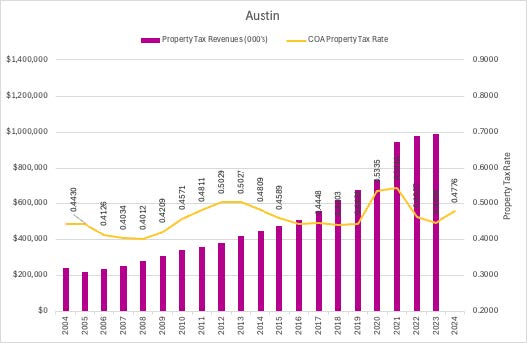
Austin’s track record says no. The only way this could be a one-time tax increase is if the City Council decided to decrease spending and collect less tax revenue next year. The last time the city’s property tax collections decreased was 20 years ago in 2005. 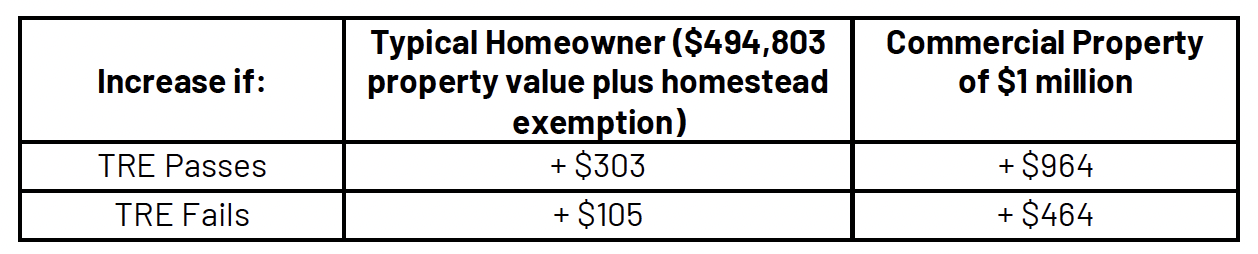
The 3.5% annual increase allowed by state law means every tax increase compounds. If the TRE passes, the higher tax rate becomes the new baseline for future years, and the city can increase 3.5% from that higher amount. Looking ahead, if the TRE passes and future City Councils only collect the extra 3.5% allowed by law each year, by 2030 the city’s collections would increase more than 33% over five years. Rejecting the TRE would limit that increase to just 19%.
No, the city is increasing a number of other rates and fees, including a 9% rate increase for services from Austin Water, a 5% increase from Austin Energy (each year for five years), and several other fees. The city’s estimates show the major rate and fee increase for the typical tax and rate payer totaling $416 if the TRE passes. The city’s budget also contains a 45-page list of fee increases that exceed 10%.
The City Council voted for a $110 million list of programs and expenses. Community Impact notes that the funding is targeted “for homelessness services, housing assistance, parks and public facilities, public health and safety, and other city services.” It’s worth mentioning that some of the Prop Q funds will go into the city’s savings account. The Council aims to keep its reserve fund at 17% of General Fund spending. Because the budget increases spending by $415 million, they need to increase their savings account balance to maintain that 17% ratio.
Maybe. The city would have to re-visit the budgeting process and find ways to reduce spending by an amount equivalent to the TRE revenues they can no longer collect. In that process, the city can reconsider and make changes to the budget. Critics of the process have said the city intentionally put certain priorities in the TRE package because they think it will attract votes. The programs and expenses used to justify the need for a TRE can still be funded if the City Council decides to restructure their priorities.
Your tax rate and tax bill is entirely dependent on the budgets set by local elected officials. Local governments adopt their budget and set a corresponding property tax rate that will raise the amount of revenue needed to fund the budget. If local elected officials spent zero dollars, your tax bill would be zero.
Is it true that the state is forcing the city to have a TRE? What role do they play in this process?
Your property tax rate and bill are determined solely by the budget a local government adopts. The State simply has a law giving voters the right to deny large property tax increases. Historically, local governments could raise property tax revenues by up to 8% each year without voter approval. In 2019, the Legislature lowered that threshold to 3.5%. Any increase above this level now requires voter approval. Interestingly, the increase from this year’s TRE proposal would still be double the voter approval threshold under the old law.
The legislature’s goal was to protect taxpayers from excessive local government budget growth, which was causing property taxes to increase at unsustainable rates. Increasing revenues by 8% every year means property tax collections could double every 9 years. The legislature’s goal was to slow that growth substantially, prevent individual property tax bills from ballooning, and give voters a meaningful voice in their local taxation.
The math works like this:

- Look up your property value on the Appraisal District’s website
- Estimate your tax bill for next year at travistaxes.com (next year’s tax info is labeled as “2025 adopted”)
- View your current and past tax bills on the Travis County Tax Office website
There may be deductions for homestead exemptions, but it’s generally that simple. For more detailed information, you can use these resources.
It depends on the budget adopted by local elected officials each year. Even if Austin doesn’t do another TRE next year, that doesn’t prevent another local government, like the county or AISD, from holding one. Additionally, the city is planning for a different type of tax increase in 2026, called a Bond Election. In July 2025, city staff recommended the Bond Election be limited to $687 million, but the City Council could choose a higher amount. As the Austin Monitor noted, the $687 million price tag would mean a property tax increase of $100 for the average homeowner. Add that to this year’s TRE request, and the City Council could raise their portion of the average property tax bill by at least $400 over the next two years.