
By the Numbers

Businesses are landing here not just for the numbers on paper — but for the energy in the air. The talent. The spirit. The sense that anything is possible.

A clear view of the region starts with the data behind it. From macroeconomic trends to local market dynamics, these indicators offer a real-time pulse on growth, investment, and opportunity across Central Texas.

Each data point tells part of a larger story—one defined by sustained momentum, a deepening talent base, and a business environment built for scale. Whether you’re evaluating expansion, tracking industry shifts, or benchmarking performance, this is where the numbers come into focus.

#1
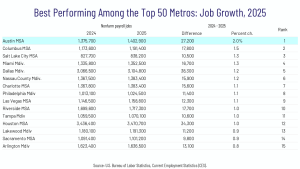
Best Performing Among Top 50 Metros for Job Growth

27,000+ jobs created in 2025

#2
for rates population growth among the top 50 U.S. metros

53,000+ new residents in 2025

#5
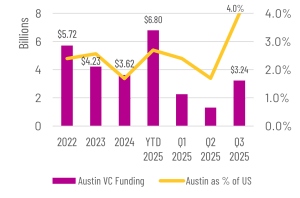
among u.s. metros for total venture capital funds raised

$7.9B+ raised by Austin startups in 2025

Economic indicators

Opportunity Austin’s research team continuously tracks and analyzes the economic indicators shaping the Austin region, from employment and venture capital activity to talent, population, and business growth.

Economic Indicators is a numbers update on select indicators in the Central Texas region that chronicle economic activity on a monthly or quarterly basis. The report and associated Excel files are posted on or about the first Wednesday of the month.

Subscribe to the By the Numbers newsletter to receive the monthly report in your inbox.

STEM Occupational Employment & Salaries – 2025

STEM occupations account for over 11.1% of all jobs in the Austin MSA in 2024, making Austin the 6th most concentrated in STEM among large U.S. metros. Since 2019, STEM occupations in Austin have grown by 17%, adding 20,000 jobs and bringing the total number of workers to 139,820.

Read More »

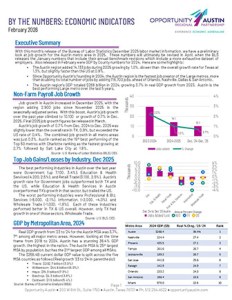
Austin Monthly Economic Indicators – July 2026

Pitchbook released their Q2 Venture Capital report, showing that companies in the Austin region raised approximately $6.5B YTD, more than twice the money raised in the same period during 2025 ($2.9B). Additionally, the Bureau of Labor Statistics released 2025 Occupational Employment and Wage Statistics, showing that the Austin region is fourth among the top 50 metros in the percent of STEM jobs.

Read More »

Austin Monthly Economic Indicators – June 2026

According to the Dallas Federal Reserve Bank’s May report, jobs in the Austin metro have grown by 6,400 for an annualized growth rate of 1.3% during the first four months of 2026. The Dallas Fed noted that in recent months, statewide growth slowed from “two primary headwinds: immigration constraining labor supply, and higher productivity suppressing labor demand in some sectors.”

Read More »

Map Room

Visual and built for exploration—the Map Room translates complex datasets into actionable geographic insight. From infrastructure and development patterns to industry clustering and mobility trends, these tools provide a spatial understanding of how the region is evolving and where opportunity is concentrated.

Population

Growth is one of the region’s defining characteristics. Population trends reveal not just how fast Central Texas is expanding, but who is choosing to be here—and why. Migration patterns, demographic shifts, and regional distribution all point to a market that continues to attract talent, investment, and long-term commitment.

Workforce Stats

A high-performing economy starts with a strong workforce. These metrics highlight labor force participation, job growth, unemployment, and educational attainment—offering a detailed view into the depth, quality, and availability of talent across the region.

Updated regularly, this data reflects both immediate labor market conditions and longer-term workforce trends shaping the future of key industries.