

Austin Region Population forecast
November 20, 2025
Chris Ramser, Vice President, Research & Joseph Morones, Director, Research
Insights
-
- Over the next 35 years, the Austin region is projected to see its population climb by more than 2 million, reaching 4.64 million by 2060, a growth of over 75%.
- Austin leads all major Texas metros with an average annual growth rate of 1.7%, while statewide growth is projected to average 1.1% through 2060.
- Mirroring statewide trends, the Austin region’s share of residents aged 65 and older is projected to rise from 13% to more than 22% by 2060, accompanied by declines in the share of residents within the 0–17 and 18–64 age groups.
- The Austin region, like Texas, will continue to become more racially and ethnically diverse, with all racial groups besides Non-Hispanic White growing in their share of the population.
The Texas Demographic Center released its population forecasts for Texas counties on September 30, 2025. Projecting population trends through 2060, these forecasts are vital for businesses, planners, developers, and other stakeholders who are planning for the medium- to long-term growth of the region.[1]
Opportunity Austin is excited to bring selected population insights for the region using these data.[2]
Regional Population Forecasts

The Austin region (comprised of Bastrop, Caldwell, Hays, Travis, and Williamson Counties) currently has an estimated population of around 2,612,775 in 2025. The region could add an additional 2 million residents by 2060, roughly 290,000 residents every five years growing to 4.64 million.[3]
For the 35-year period Austin does not quite double but will be 77.7% larger than the baseline 2025 estimate.

Austin’s average annual growth rate of 1.7% for the 35-year period beats all major Texas metros. Statewide, Texas is projected to grow by 1.1% annually.[4]
Houston’s rate of growth at 1.4% slightly exceeds Dallas’ at 1.3%, while Fort Worth and San Antonio could both average 1.1% over the 35-year period under this scenario.
Growth by County

According to the projections, Hays County’s population will double in the next 35 years, growing from 301,000 in 2025 to 612,000 in 2060. While Williamson County is not projected to double during this particular time span, the county’s 2050 population could be twice the size of its 2020 population of 615,631. The region’s largest county is expected to remain Travis County growing to 2.35 million from 1.39 million in 2025. Under this scenario, Bastrop could reach 200,000 by 2060, while Caldwell’s population would exceed 80,000.[5]
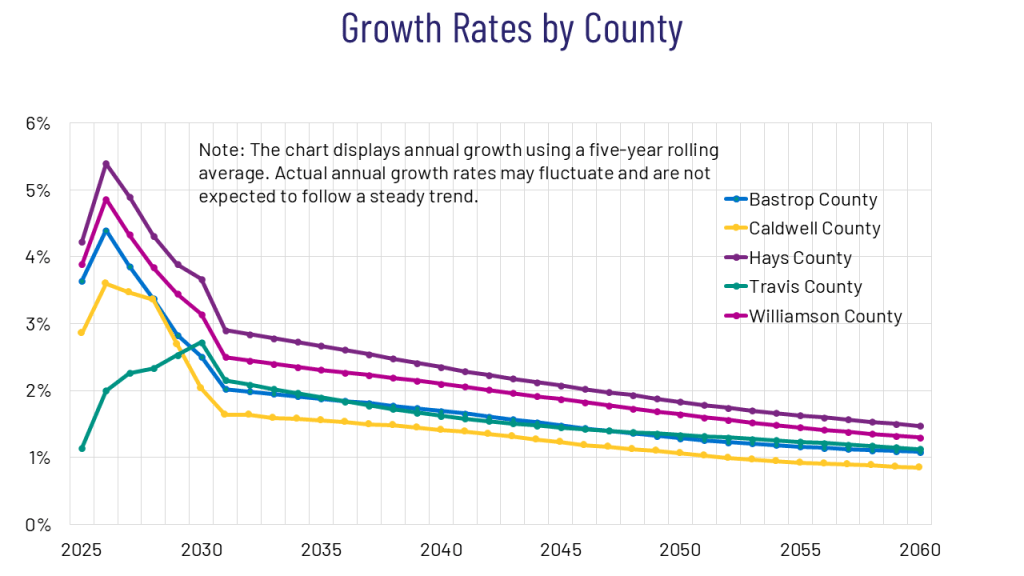
In all cases, the scenarios predict higher growth rates for each county in the early years of the projection with more conservative rates by 2060. For the first 10 years of the projection (through 2035), average annual growth rates of 3.4% are forecast for Hays County followed by 2.9% in Williamson, 2.4% in Travis, 2.3% in Bastrop, and 1.9% in Caldwell. Rates are 0.7% to 0.9% less for each county in the final 15 years of the projection (from 2035 to 2060).
Population by Age Group
Included among the data released are population projections for each Age and Race/Ethnic group. These data provide policymakers with a tool for understanding potential changes in the composition of the region’s workforce as well as prioritizing needs for social service, education, housing, and similar considerations.
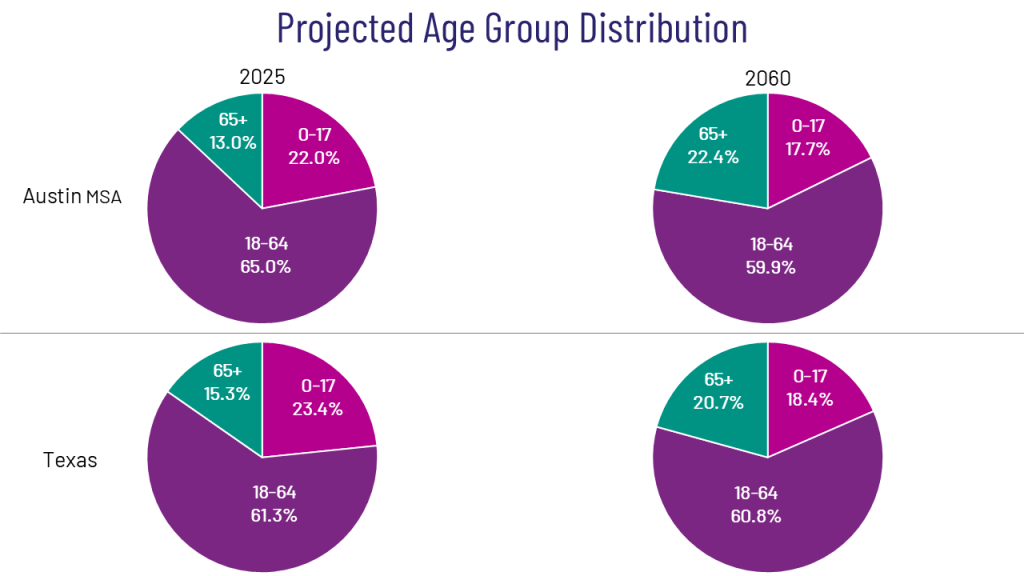
Following national and statewide trends, the Austin MSA’s age distribution is expected to get older in the coming years. Gradually, the percentage of young residents is expected to decline due in part to shrinking birth rates observed nationally. In Austin, the working age population (18-64) currently represents 65% of the total population, significantly higher than Texas’ percentage of 61.3%. Austin’s share of population aged 65+ is just 13.0% in 2025, but that category is expected to grow the fastest up to 22.4% in 2060.

The total number of people in each age group in the Austin MSA is expected to increase throughout the next 35 years, however, varying levels of growth in each group account for the shifting age distribution. From 2035 to 2060, the population aged 65+ is expected to double, adding over 500,000 people, while the working age population (18-64) is expected to grow by just 33.8%, adding 700,000 workers. By 2060, the number of children aged 0-17 could grow by 162,000 or 24.3%from 2035.
Population by Race/Ethnicity
The Austin MSA, like Texas, will continue to see growth in all Race/Ethnic categories except for Non-Hispanic Whites over the period from now until 2060.[6]

In Austin, the Non-Hispanic White population is currently approximately 46.0%. By 2060, this percentage will decrease to 28.9%. The Hispanic population is currently 33.6% and forecasted to grow to 40.8%. The Black population will grow from 7.8% to 12.2%, while the Asian population increases from 7.7% to 12.0%. All other races will increase from 4.9% to 6.2%.
At the state level, Non-Hispanic Whites currently make up 37.7% of the population, a share projected to decline to 25.2% by 2060. The Hispanic population is expected to grow from 40.6% to 47.1%, while the Black population increases from 12.0% to 12.7%, and the Asian population from 5.9% to 9.4%. The combined category “All other races” is also projected to rise, from 3.9% to 5.6%.

 Conclusion
Austin is poised to lead the State in growth over the next 35 years. Based on the high growth scenario, the region could see its population reach 3.23 million in 2035, and by the end of that year the population of the Austin MSA is expected to surpass the San Antonio MSA. With an overall population of 4.64 million by 2060, the Austin region when combined with San Antonio’s 4.14 million will be larger than the current DFW metroplex.[7]
The Austin region, much like Texas overall, will continue to experience an aging population, increasing the demand for medical care and social services. Shifts in demographics will also impact schools and childcare systems, while the region’s racial and ethnic composition will continue to diversify.
Already recognized as one of the most attractive places to start and grow a business—thanks to our skilled labor force, high quality of life, and business-friendly environment—managing regional growth will be a critical priority for local leaders and will present some challenges as well as many opportunities. Staying engaged with Opportunity Austin is an impactful way to prepare for the region’s future.
Download this excel workbook for select excerpts of the larger TDC Population Projections used in our analysis.
Footnotes
[1] The Texas Demographic Center released three growth scenarios including, a low, mid and high migration forecast. The Center recommends the mid migration scenario that assumes similar migration patterns as the past two decades for most uses, while the high scenario is recommended for use when migration levels are high. A full report on their methodology for their data and forecasts can be found here, under the “Projections & Methodology” section below the table.
[2] Opportunity Austin’s analysis is based on using the high growth scenario, which yields an average annual increase of 58K new residents each year through 2060. This level of growth is not out of the question for a region as dynamic as Austin. In fact, based on Census Population Estimates, the Austin region has added an average of 65K new residents each year since COVID, while the prior decade (2010-2020) saw an average increase of 56K per year.
[3] The mid-growth scenario forecasts the Austin region reaching 4,330,172 residents by 2060, while the low-migration scenario projects 4,124,390. Under the mid scenario, the region adds about 245,000 residents every five years; under the low scenario, about 216,000.
[4] Texas’ population of 31.75 million in 2025 is expected to grow to 46.17M in the high growth scenario, while the mid scenario results in a 2060 population of 42.60M. The low scenario forecasts 40.26M. A presentation developed by the TDC staff detailing additional state-level insights can be found here.
[5] Although population growth in smaller adjacent counties like Bastrop and Caldwell is difficult to predict, both have the potential to exceed current projections. Their forecasts are based largely on historical trends and do not account for future economic development initiatives that could accelerate growth.
[6] For all categories except for Hispanic, the TDC uses the prefix “Non-Hispanic” to avoid potentially double counting Hispanic residents. For formatting sake, the prefix was removed from each category name, but data was unaltered.
[7] DFW consisting of both Fort Worth and Dallas metro divisions totaled 8.34 million in 2025. By 2060, the DFW metroplex is projected to reach 13 million.