

Job Growth & Unemployment, September 23, 2024
Beverly Kerr, Vice President, Research
Insights
-
- Austin is the 27th best performing among the top 50 metros, adding 17,300 jobs, or 1.3% growth, in the year ending in August.
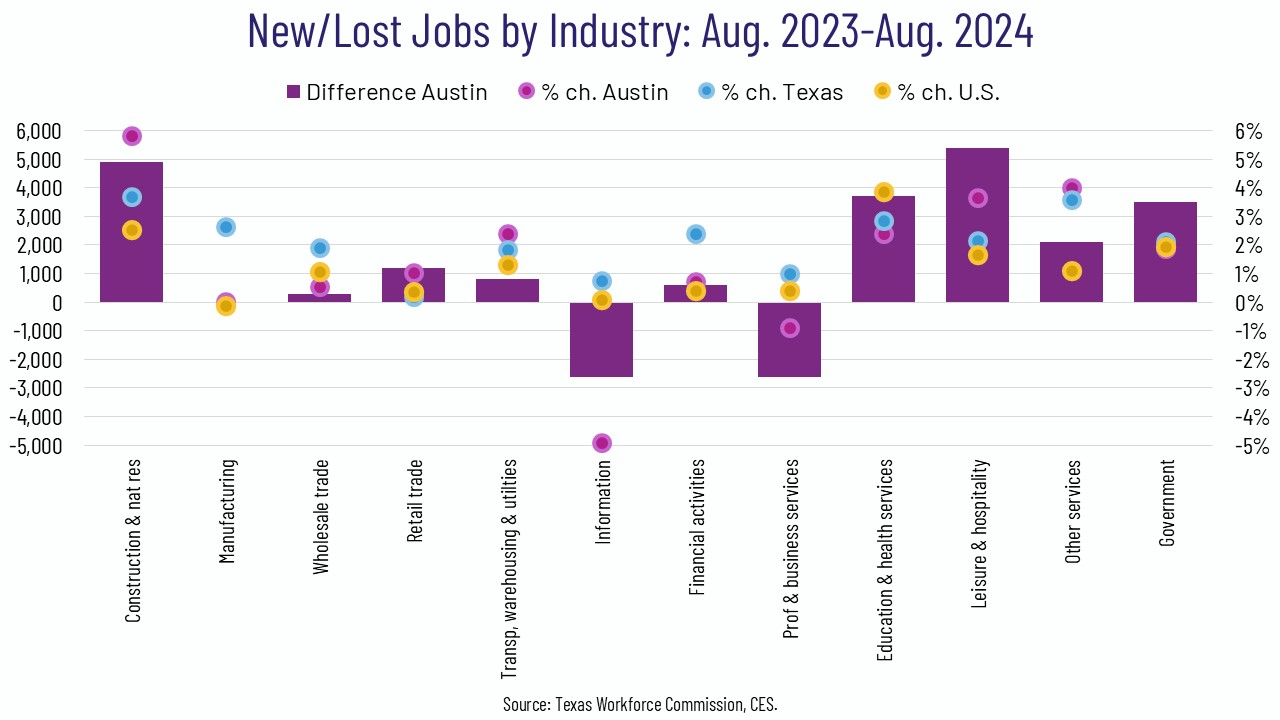
- The fastest job growth over the last 12 months occurred in Austin’s construction and natural resources (5.8%) and other services (4.0%) industries.
- Two industries lost jobs over the last 12 months: professional and business services (0.9%) and information (4.9%).
- Austin’s seasonally adjusted unemployment rate is 3.4% in August, unchanged from the preceding five months.
Nonfarm payroll jobs
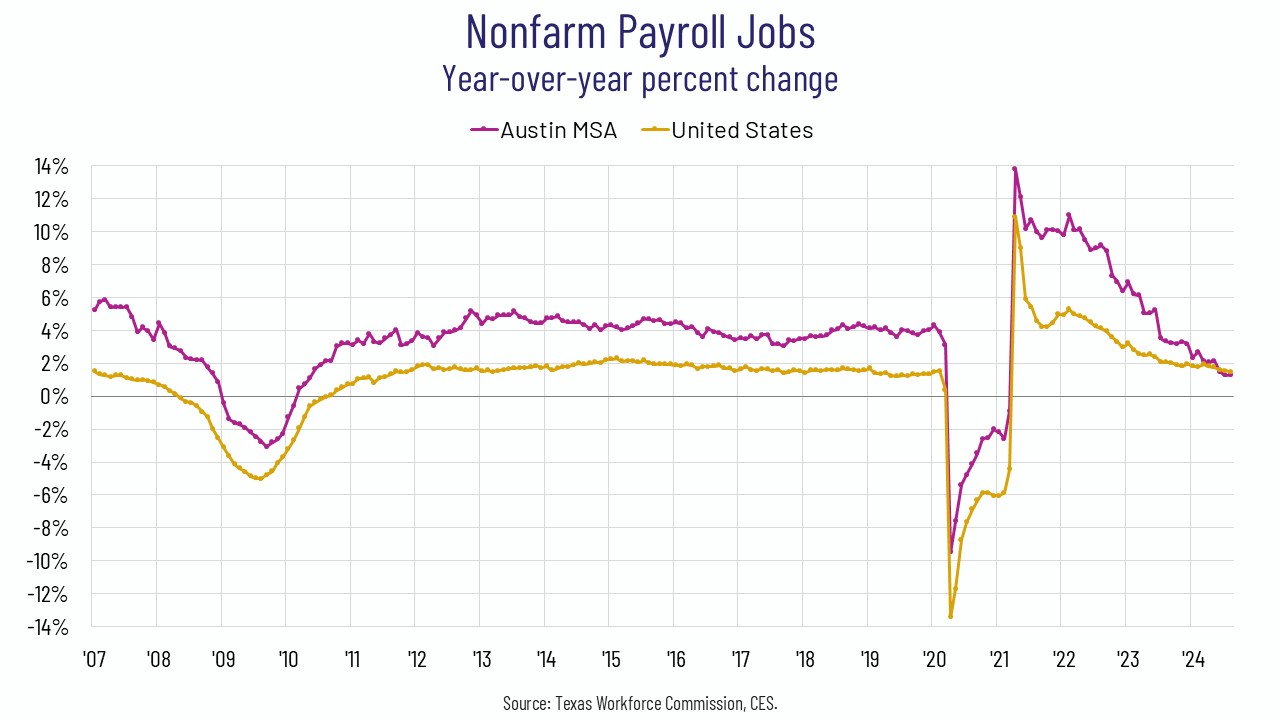
Revisions to last month’s estimate for July reduced the Austin metro’s previously reported year-over-year (YOY) growth from 1.4% to 1.2% according to Friday’s releases of monthly labor market data by the Texas Workforce Commission. And the U.S. Bureau of Labor Statistics. However, YOY job growth ticks up to 1.3%, or 17,300 jobs, with the August estimate. On a seasonally adjusted basis, Austin jobs increased by 6,000 or 0.4% from July to August.

Austin’s YOY increase of 1.3% makes it the 27th best performing among the 50 largest metros. Two Texas metros, Houston and San Antonio, rank in the top 10 this month. Job growth is 2.6% for the top 10 fastest growing metro areas in aggregate. Fort Worth (1.8%) and Dallas (1.2%) rank 17th and 29th respectively. Four of the 50 largest metros saw negative job growth over the last 12 months.

For the year ending in August, private sector job growth in the Austin MSA is 1.2%, or 13,800 jobs, with gains across eight of the 11 major private industry sectors. Total job growth was higher at 1.3% as the government sector, which accounts for 15% of metro area employment, grew by a relatively strong 1.9%.

Texas saw net private sector job growth of 2.0% with all private industry groups adding jobs over the last 12 months. Total job growth was also at 2.0%, due to comparable (2.1%) growth in the government sector. For the nation, private sector job growth was 1.4% for the 12 months ending in August with all but one private industry adding jobs. Overall job growth was slightly higher at 1.5%, due to relatively strong 1.9% government sector growth.
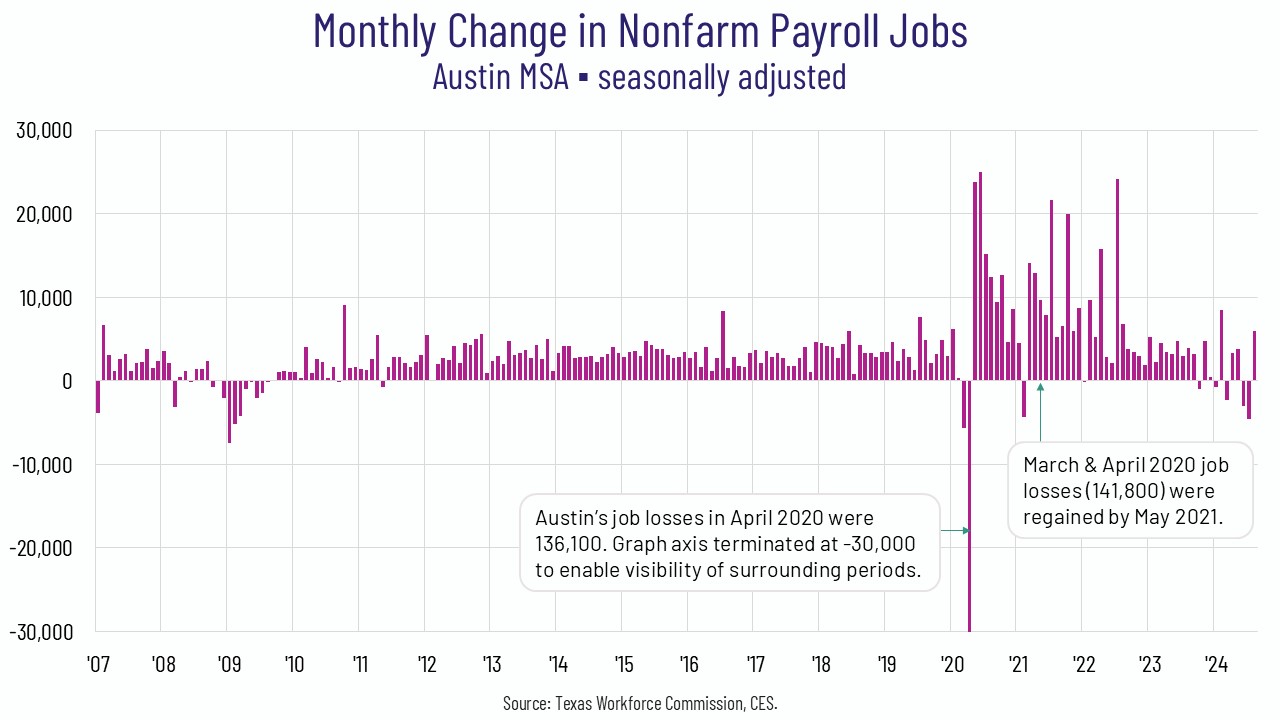
Jobs in August are up by 4,200 jobs or 0.3% from July in the not-seasonally-adjusted series for Austin. The seasonally adjusted series also shows positive job growth with a gain of 6,000 jobs or 0.4%. Seasonally adjusted job growth was also positive across the other major Texas metros. San Antonio was up by 1.0%, Houston by 0.9%, Dallas by 0.07%, and Fort Worth by 0.5%. Statewide, seasonally adjusted jobs are up by 78,000 jobs or 0.6%. Nationally, seasonally adjusted jobs are up from July by 142,000 or 0.1%.
In Austin, eight of the 11 major private industry sectors added jobs over the last 12 months. Construction and natural resources is the fastest growing (5.8% or 4,900 jobs) and leisure and hospitality added the most jobs (5,400 or 3.7%). Other services was also relatively fast growing (4.0% or 2,100). The two industries with negative YOY growth were information (down 4.9% or 2,600 jobs) and professional and business services (down 0.9% or 2,600). Manufacturing was unchanged.
In August, Austin’s professional and business services employment is at 281,700, which is roughly the level it attained in August 2022. The last peak for the industry was 292,200 jobs in November 2023. Current jobs are 10,500 (3.6%) below that peak. Information, with 50,200 jobs in August, is 4,500 (8.2%) below its February 2023 peak.
Those two industries combined accounted for 38% of jobs created in Austin between 2013 and 2023, so their slowing or contracting in 2024 accounts for a large part of the recent overall slowing of job growth. If information and professional and business services were excluded, the region’s job growth over the last 12 months would be 2.3% instead of 1.3%. Many of the tech companies announcing layoffs over the last year-plus are in these industries. The public announcements of these layoffs often lacked detail for local impact, but plainly Austin is seeing its share.
While the YOY numbers for these sectors have been concerning, looking at July to August change is something of a different story. Professional and business services jobs grew by 1,800 jobs or 0.6% over the month. That’s more than half of all private sector jobs added in August.
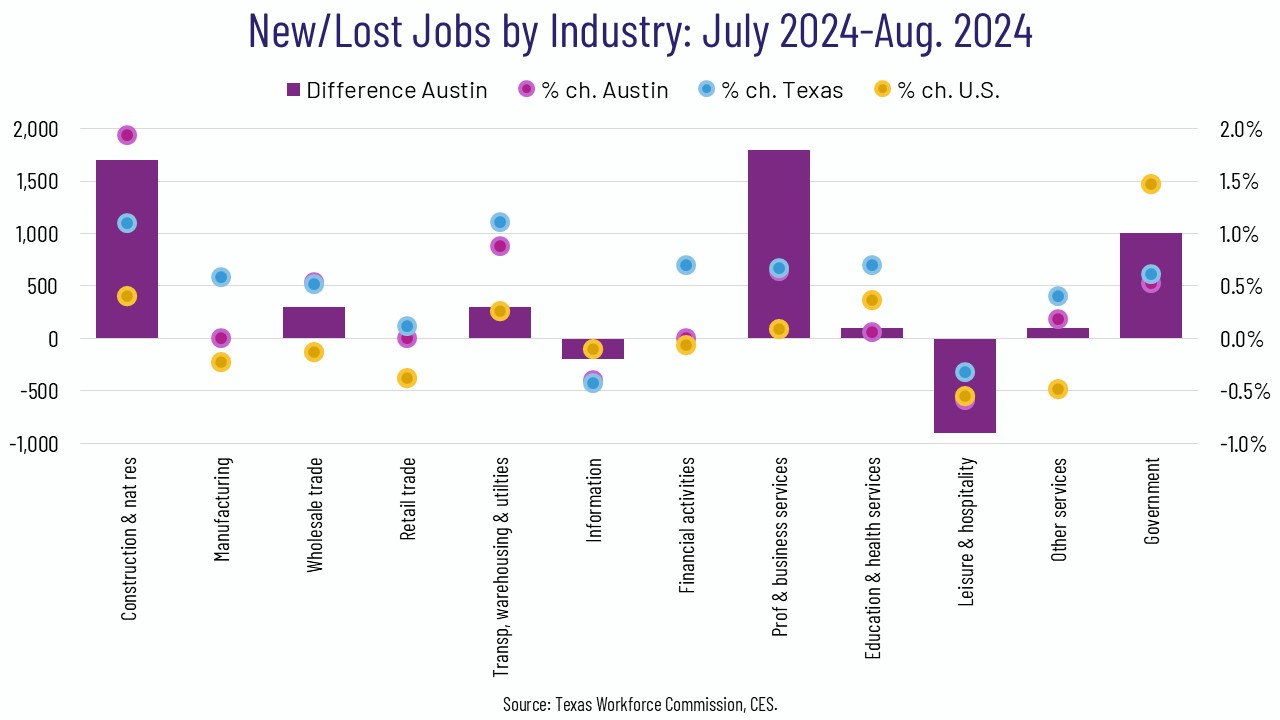
Statewide, the private industries with the most significant YOY growth are construction and natural resources and other services, increasing 3.7% and 3.6% respectively. No industries lost jobs over the last 12 months.
Nationally, education and health services (3.9%) and construction and natural resources (2.5%) were the leading private sector growth industries over the last 12 months. Manufacturing (-0.1%) lost jobs.

Over the last 12 months, the net gain for private service-providing industries in Austin is 8,900 jobs, or 0.9%. Employment in goods-producing industries is up by 4,900 jobs or 3.1%. Statewide, private service-providing industries are up 174,600 or 1.8%, and goods-producing industries are up 63,200 or 3.2%.
With each third-Friday release of labor market data, the Dallas Fed revises their Texas Employment Forecast for 2024. In June, the forecast was relatively strong, estimating that statewide jobs would increase 2.4% in 2024. In July and in August the forecast was revised down to 1.9% and then down to 1.6%. This month brings a bounce back with the forecast estimating that Texas jobs will increase 2.2% in 2024. While Hurricane Beryl impacted Texas employment in July, the effect was transitory and Texas employment rebounded in August according to Luis Torres, Dallas Fed senior business economist. In addition to job growth through August, the forecast is based on projected national GDP, oil futures prices, and the Texas and U.S. leading indexes.
Additional graphs: The trend since 2000 for six large industries and six small industries.
Labor force, employment & unemployment
We also now have August labor force, employment, and unemployment numbers for Texas and local areas in Texas. The same data for all U.S. metros will not be released by the U.S. Bureau of Labor Statistics until October 2. In July, Austin had the 9th lowest rate of unemployment among the 50 largest metros. Data for August show Austin sustains its superior performance relative to the state and the other major Texas metros.
.
In August, Austin’s not-seasonally-adjusted unemployment rate is 3.7%, just above the 3.6% rate seen a year ago. Rates in the other major Texas metros range from 4.0% in San Antonio to 4.7% in Houston. Dallas and Fort Worth are at 4.1%. San Antonio is unchanged from one year ago, while the other major metros are 0.1 to 0.2 percentage points higher than last year. The statewide rate is now 4.4%, up from 4.2% in August of last year. The national unemployment rate is 4.4%, up from 3.9% a year ago.
August unemployment rates are 3.6% in Travis County, 3.7% in Hays County, 3.8% in Williamson County, 3.8% in Bastrop County, and 4.1% in Caldwell County.

On a seasonally adjusted basis, Austin’s August unemployment rate is 3.4%, unchanged from the preceding five months. The statewide rate is 4.1%, unchanged from July. The national rate is 4.2%, down from 4.3% in July.

Among Texas’ other major metros, San Antonio is at 3.8%, Dallas at 3.9%, Fort Worth at 4.0%, and Houston is at 4.5%. Seasonally adjusted unemployment rates for Texas metros are produced by the Federal Reserve Bank of Dallas. (The Texas Workforce Commission also produces seasonally adjusted rates for Texas metros, but publication lags the Dallas Fed’s estimates.)
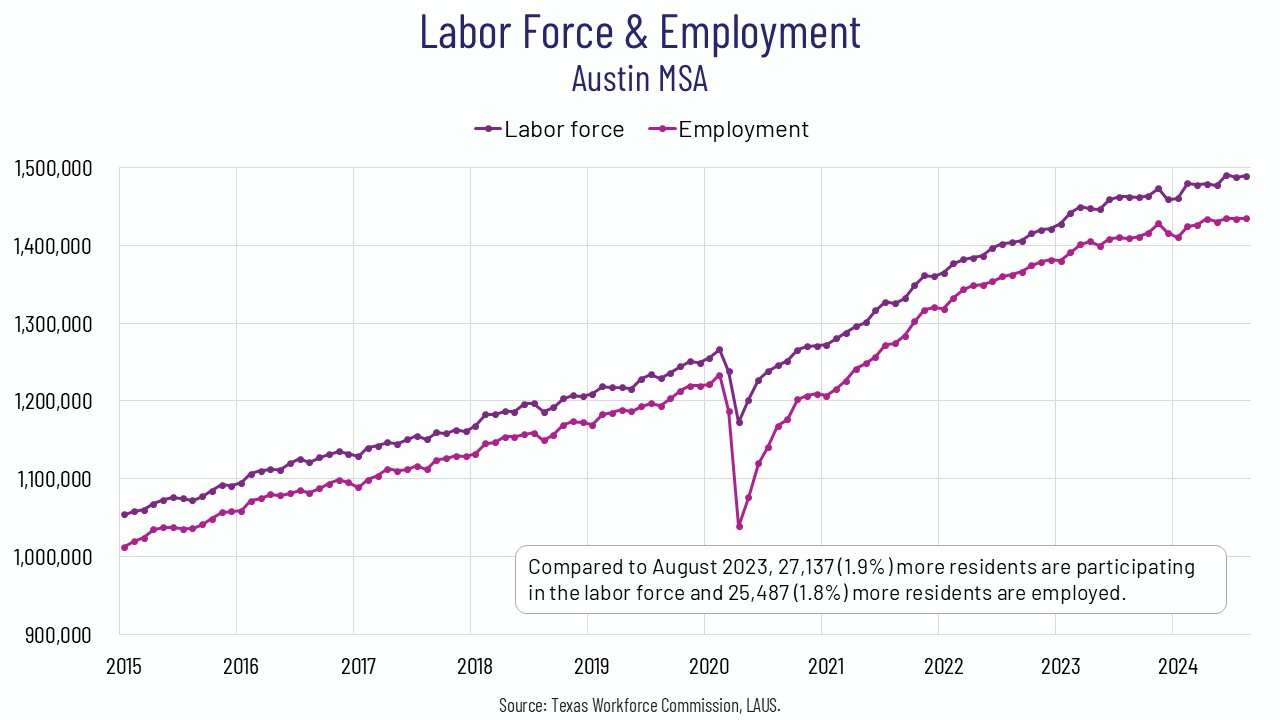
With Austin’s unemployment rate up from one year ago, the number unemployed has increased. In August 2023, Austin’s number of unemployed was 52,893. Over the last 12 months, the unemployed increased by 1,650 or 3.1%, to 54,543. This is due to a smaller increase in the number employed, compared to the labor force. The Austin metro’s civilian labor force (employed plus unemployed) increased by 27,137 persons or 1.9% from one year ago, while persons employed increased by 25,487 or 1.8%.
Additional graphs – Labor force & employment: Texas and United States
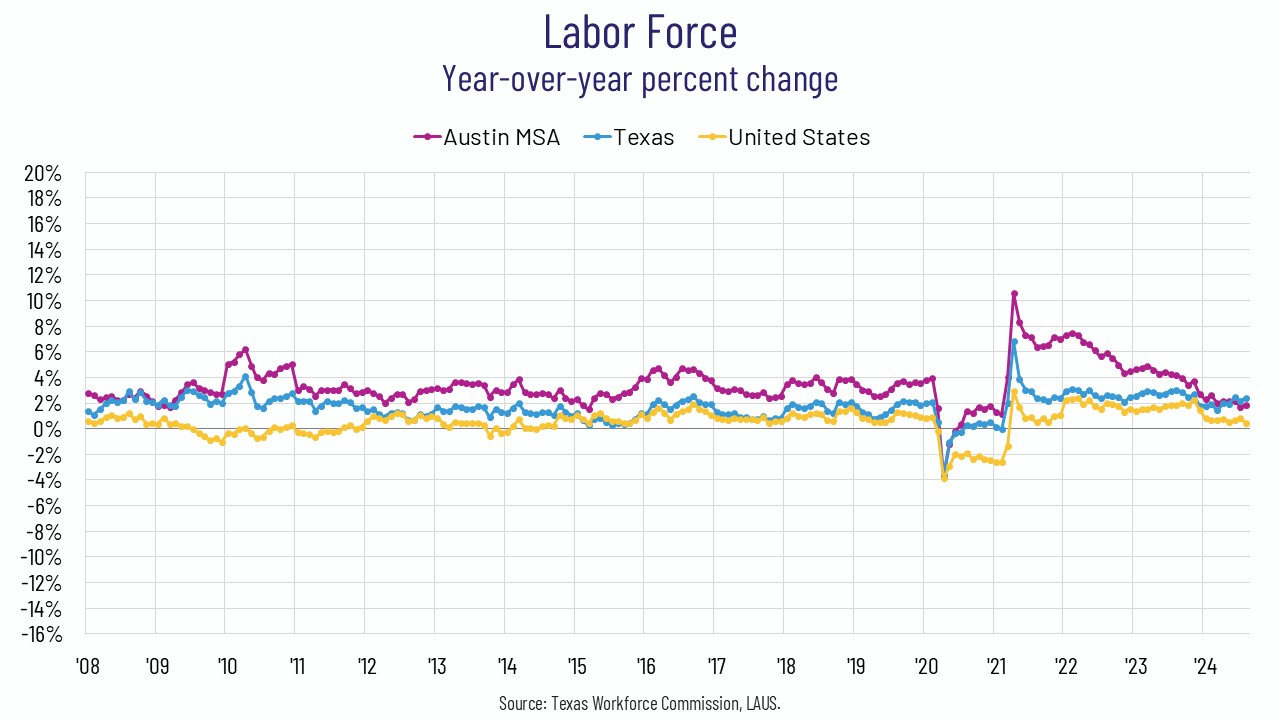
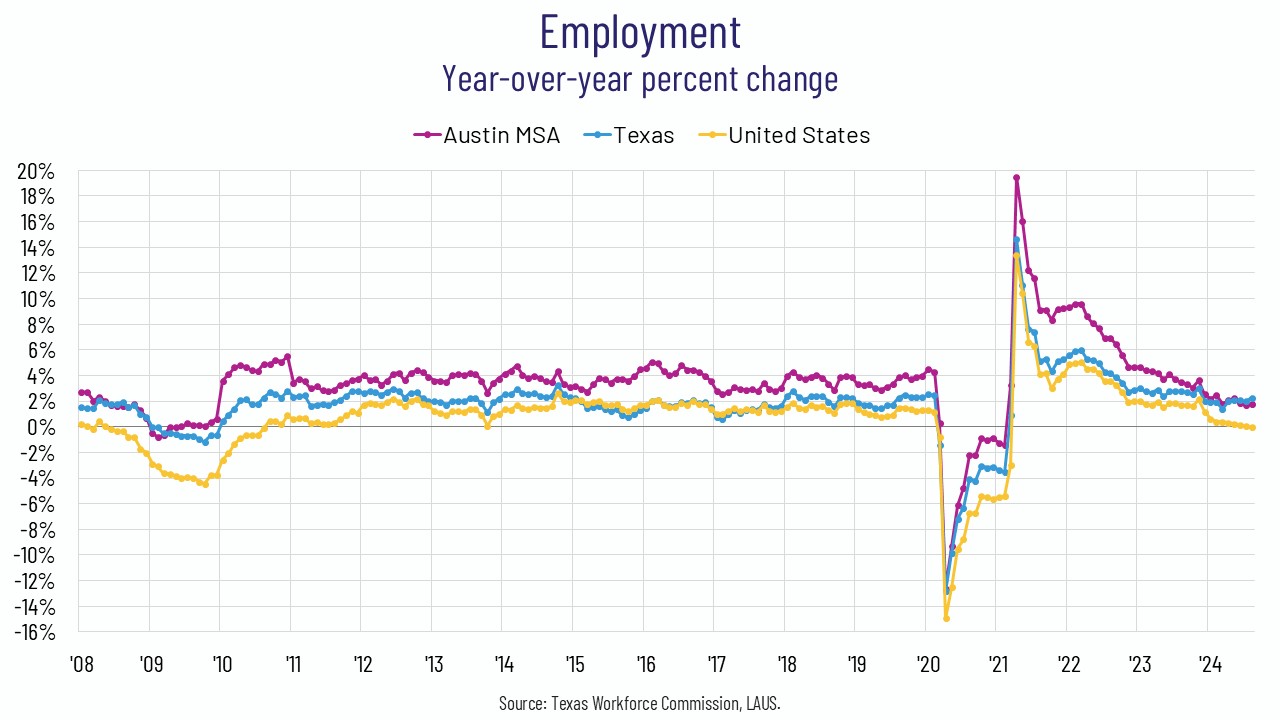
Texas’ labor force growth (362,018 or 2.4%) over the last 12 months exceeds the growth in the number employed (325,724 or 2.2%). Thus, the number of unemployed increased by 36,294 or 5.7%. Nationally, August’s labor force is up by 714,000 or 0.4%, while the number employed is below the level of a year ago by 79,000 or 0.0%, and 792,000 more people (12.0%) are unemployed.
 Conclusion
Recent months have seen Austin’s and Texas’ job growth slow. Austin’s YOY job growth averaged 5.7% in the first half of 2023, then 3.3% in the second half. That slowing continues in the first eight months of 2024 with YOY growth averaging 1.9%. For August, YOY growth is 1.3%—which ranks Austin 27th and in the middle of the pack among the top 50 metros. Between the Great Recession and the pandemic, Austin’s annual average growth ranged from 3.4% to 4.7% and averaged 4.0%.
For Texas, growth averaged 4.1% in the first six months of 2023, followed by an average of 2.6% for the last six months of the year. As in Austin, average YOY job growth in 2024 falls farther, averaging 2.0%. Texas’ YOY growth for August is also 2.0%.
Austin’s YOY job growth has been lower than the state’s for four months. The last time this was seen was during the early 2000s dot.com recession. Looking at month-to-month percent change in the seasonally adjusted series, Austin outperformed the state in only one month of 2024.
Despite the recent performance on payroll job creation, Austin is sustaining an unemployment rate superior to the state and the other major Texas metros. In fact, Austin has returned to the top 10 best performing major metros, having the ninth lowest unemployment rate in July. August estimates for all U.S. metros are not yet available.

The Texas Workforce Commission and the U.S. Bureau of Labor Statistics will release September estimates on October 18.