
The Austin economy
For our March Economic Indicators report, we are excited to have Savannah Rakowitz, OA’s new Research Intern, contribute to our analysis. The report is a shortened version, since the only Federal datasets released were from the U.S. Patent Trademark Office and the U.S. Census Bureau Building Permits Survey. The monthly jobs data from the BLS is still only available through Dec. 2025. This month, we present a special analysis ranking U.S. patent awards for metro areas. Late arrivals this month include new population estimates for 2025 for metros and counties. A more in-depth analysis of that release will come later, but the Austin metro added 53,700 new residents from 2024 to 2025. With annual growth of 2.1%, Austin ranked second, behind only Raleigh (growth of 2.4%), as the fastest-growing large metro. Here are some additional insights:
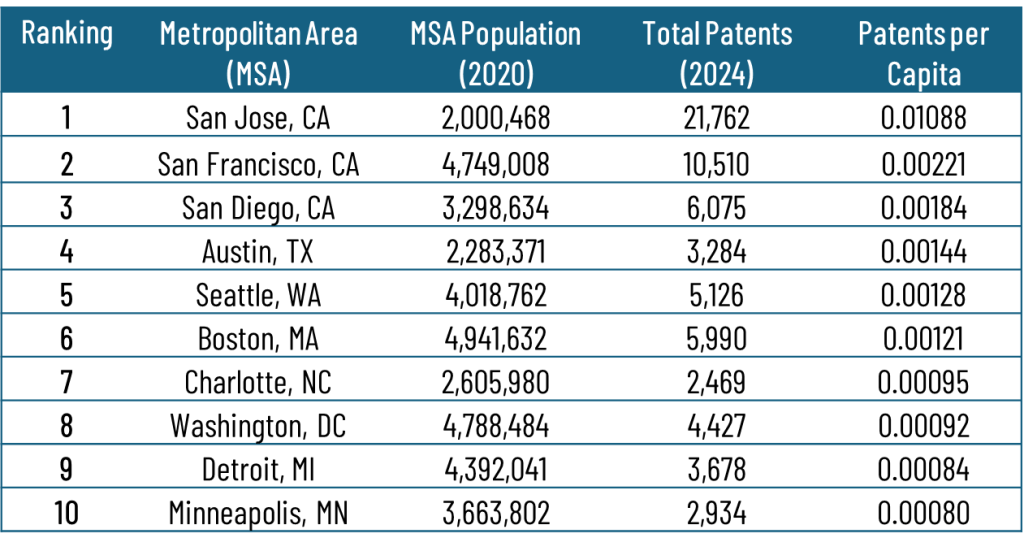
- Austin ranked #4 in the U.S. for highest patents per capita among the top 50 MSAs in 2024, behind only Silicon Valley and San Diego. Austin also ranked #1 in Texas and the Southwestern U.S for highest patents per capita.
- For March 2026, the City of Austin received $28.4 million in sales tax allocations, up 4.3% from March 2025.
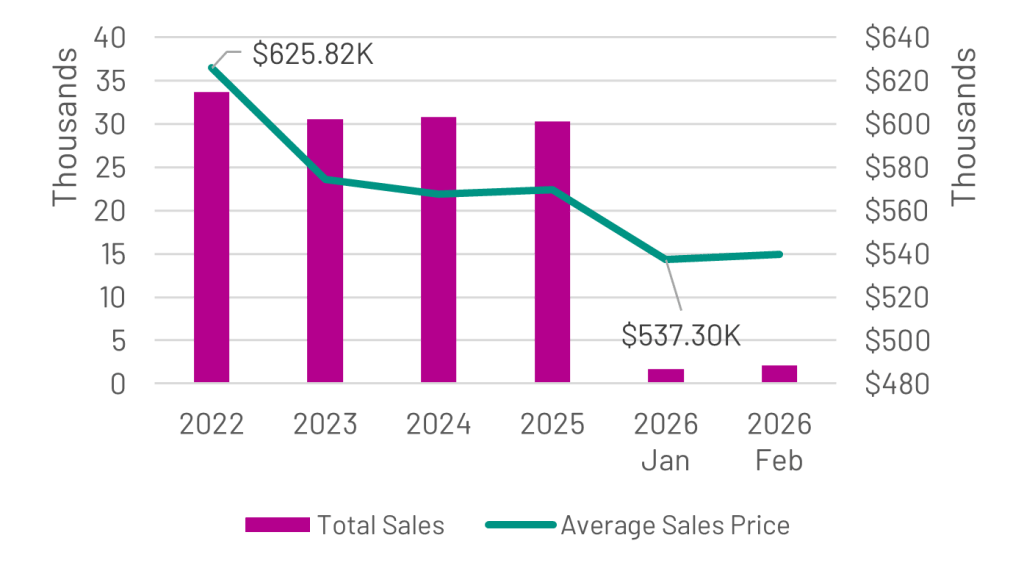
- The average sales price in the Austin region was $539,640 in February, down from $559,991 one year ago. Home sales in February totaled 2,128, increasing by 24% from the previous month..
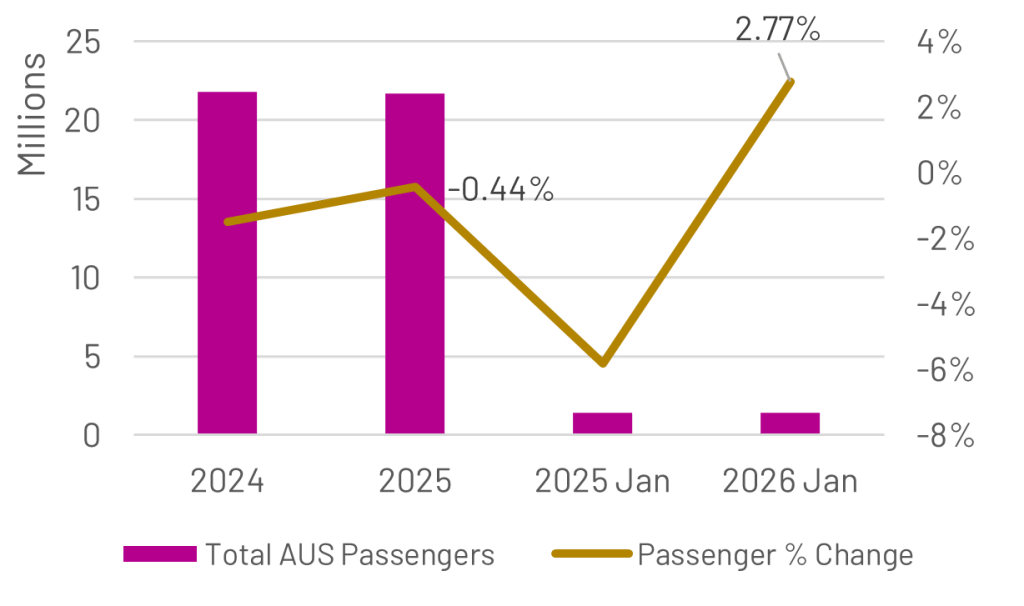
- AUS passenger enplanements increased by 3% compared to January 2025, with 1,435,466 total passengers.
Patents per Capita Metro Ranking, 2024
The Austin region ranked #4 in the United States for highest patents awarded per capita of the top 50 U.S. MSAs in 2024. This remarkable feat, based on 2020 U.S. Census population data, makes Austin the #1 MSA in Texas for highest patents per capita, ahead of Dallas, Houston, and San Antonio and in the Southern United States. This places Austin ahead of prominent cities such as Seattle, Boston, Charlotte, and Washington D.C. In 2024, the Austin region saw over 3,200 patents awarded, emerging within the top 15 MSAs of the highest number of patents awarded.
Source: U.S. Patent Trademark Office.
Patent Application Activity
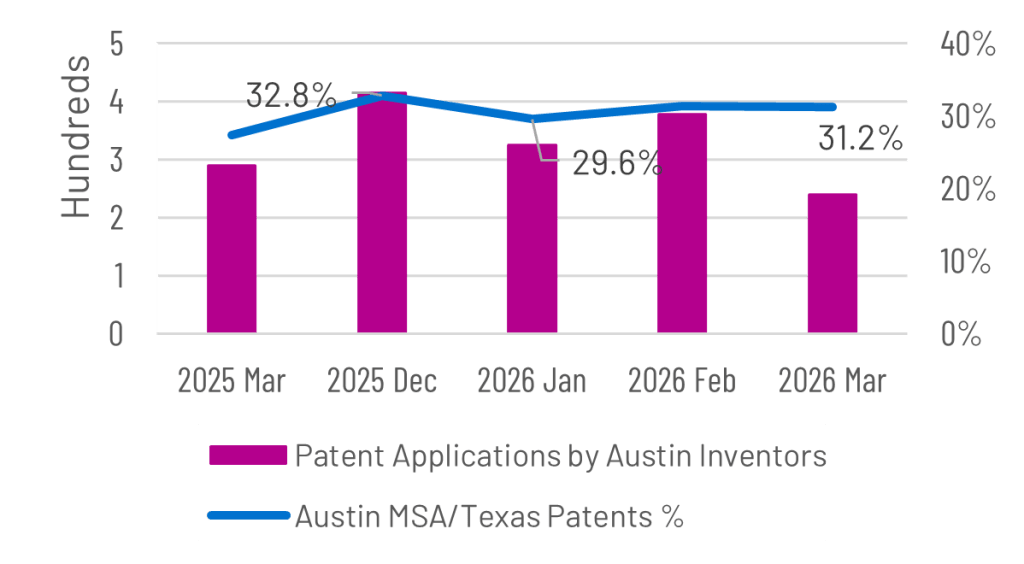
Austin inventors are averaging an impressive 4,500 patents applied each year during the 2020’s, which is higher than the 3,750 averaged during the 2010’s. For March 2026, Austin inventors applied for 239 patents, a 17.5% decrease from March 2025. Austin rose to encompass 31% of Texas’ total patent applications. This is a truly remarkable data point since the Austin MSA only represents around 8% of the entire population of the state.
Source: U.S. Patent Trademark Office.
Sales Tax Receipts
Sales tax allocation payments to the City of Austin totaled $356 million in 2025, a slight increase of 0.4% over 2024. Previously, payments were up 2.4% in 2024 and 3.3% in 2023. For March 2026, the City of Austin received $28.4 million, up 4.3% from March 2025.
In Round Rock, receipts totaled $129M and were up 10.5% in 2025 following a drop of -1.4% in 2024 and growth of 1.4% in 2023. San Marcos received 0.5% more in sales tax receipts in 2025 to $39M, which follows a decline of -2.1% in 2024 and growth of 4.2% in 2023. For March 2026, receipts were down 13.7% in Round Rock and up 0.3% in San Marcos year over year.
Source: Texas Comptroller.

Housing Permit Activity
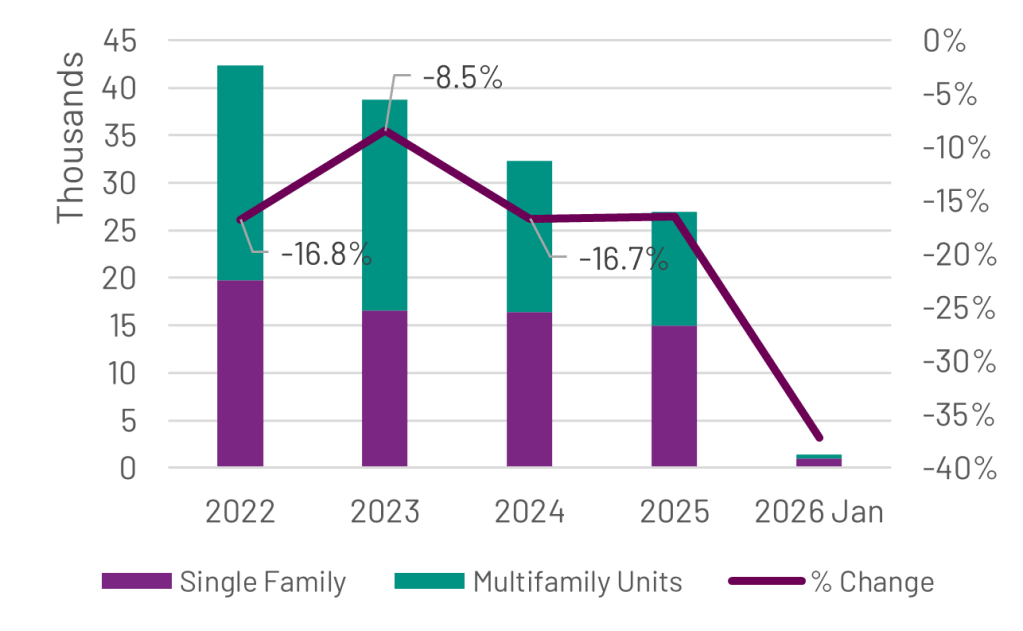
Building permits issued in the Austin region came down from historic highs of between 42,000 to 51,000 units in 2021 and 2022. In 2025, a total of 26,964 units were issued, down 16.5% from last year when 32,294 were approved. Nationally, permits were down 3.5% in 2025 compared to 2024.
For the second year in a row, the share of single-family units approved in the Austin region (55.5%) exceeded multifamily permits., following three years (2021-2023) where more multifamily permits were issued. In January 2026, new privately-owned housing units decreased by 37.2% from the previous month, compared to the United States’ new privately-owned housing units falling 3.3% from December 2025.
Source: U.S. Census Bureau Building Permits Survey.
Home Sales
Home sales in the Austin region peaked at 41,094 in 2021. For the last three years, total sales were about 30,500. Preliminary sales totaled 30,278 in 2025, down 500 from last year, or -1.8% Nationally, sales were essentially unchanged up 1,000, while statewide sales were up 1.3% or 4,200 homes.
The average sales price in the Austin region was $539,640 in February 2026, down from $559,991 one year ago. In Feb. 2026, months on inventory in Austin was 4.4 months, down from 5.9 early last summer. Months of Inventory is 0.5 months higher than one year ago.
Source: TX A&M Real Estate Research Center.
AUS Airport Passenger Activity
Total domestic passengers at AUS Airport fell to 1,435,466 passengers, a 27% decrease from December 2025. This comes amidst a slower travel month for the U.S. after the busy holiday season from October to December. However, passenger enplanements jumped by 3% compared to January 2025. In 2025, total passengers at AUS dropped by 0.9% from 2024 with a total of 10,563,797 passengers.
Total cargo (including Belly freight, cargo and mail) totaled 19.1 million pounds in January 2026, down 6% from 24.6 million pounds in January 2025.
Source: City of Austin.
Upcoming Releases
Opportunity Austin will continue to update economic indicators and will return to the normal range of statistics including job growth, unemployment & housing permits in April. The Bureau of Labor Statistics (BLS) is set to release its March 2026 Consumer Price Index report on April 10th and its monthly employment report for metro areas on April 16th. The Texas Comptroller of Public Accounts is set to release its February sales tax allocation report on April 9th, and the U.S. Census Bureau will also release its March housing permit report on April 29th.
More Info & downloads
- Labor force, employment & unemployment
- Employees on nonfarm payrolls
- Hours & earnings
- Consumer price index
- Metro business cycle index
- Sales tax & retail sales
- Housing permits
- Home sales, listings & prices
- Air service
- Patent activity
- Commercial real estate
For questions about this report, please contact our Research Team: Chris Ramser, Vice President, Joseph Morones, Director, and Savannah Rakowitz, Intern.