

Job Growth & Unemployment, April 8, 2025
Chris Ramser, Vice President, Research
Insights
-
Austin’s job growth in 2024 outperformed earlier projections, according to revised data released in late March by the U.S. Bureau of Labor Statistics (BLS).
-
With 28,500 jobs added and a growth rate of 2.1%, Austin ranked as the 5th fastest-growing major metro—up from the previously reported 10th place and a 1.7% growth rate (22,700 jobs).
-
Over the past 12 months, job gains were strongest in education & health services (5.7%), followed by financial activities (4.5%) and construction & natural resources (3.2%).
- Austin’s seasonally adjusted unemployment rate rose to 3.5% in February, up from 3.4% in January.
Nonfarm payroll jobs
Job growth in 2024 for the Austin region exceeded earlier projections, based on annual benchmark revisions from the U.S. Bureau of Labor Statistics (BLS) released in late March. Previously, Austin’s 2024 job growth was estimated at 1.7% (22,700 jobs), placing the region as the 10th fastest-growing large metro. Revised data now shows 2.1% growth with 28,500 jobs added, moving Austin up to the 5th fastest-growing large metro in the U.S.

Before the BLS revisions, the Austin metro was consistently lagging Texas in year-over-year job growth for much of 2024. However, with the updates to the CES survey, Austin’s traditional lead over Texas was reinstated for all of 2024. To revisit the preliminary numbers release in our last By the Numbers article, click here.

In addition to the benchmark revisions for 2024, we now have more job growth data. For the year ending in January, the Austin metro added 22,300 jobs (1.7% growth) with 14,100 private service-providing industries, 1,500 in private goods-producing industries, and 6,700 government jobs.

In Austin, eight of the 11 major private industry sectors added jobs over the last 12 months. Education & health services is the fastest growing and added the most jobs (5.7% growth or 8,900 jobs). Financial activities and construction, natural resources & mining were also growing relatively fast at 4.5% and 3.2%, respectively. The three industries with negative YOY growth were information (down 5.7% or 2,900 jobs), manufacturing (1.6% or 1,200 jobs), and transportation, warehousing & utilities (0.3% or 100 jobs). Professional & business services grew by 2,300 jobs or 0.8%.
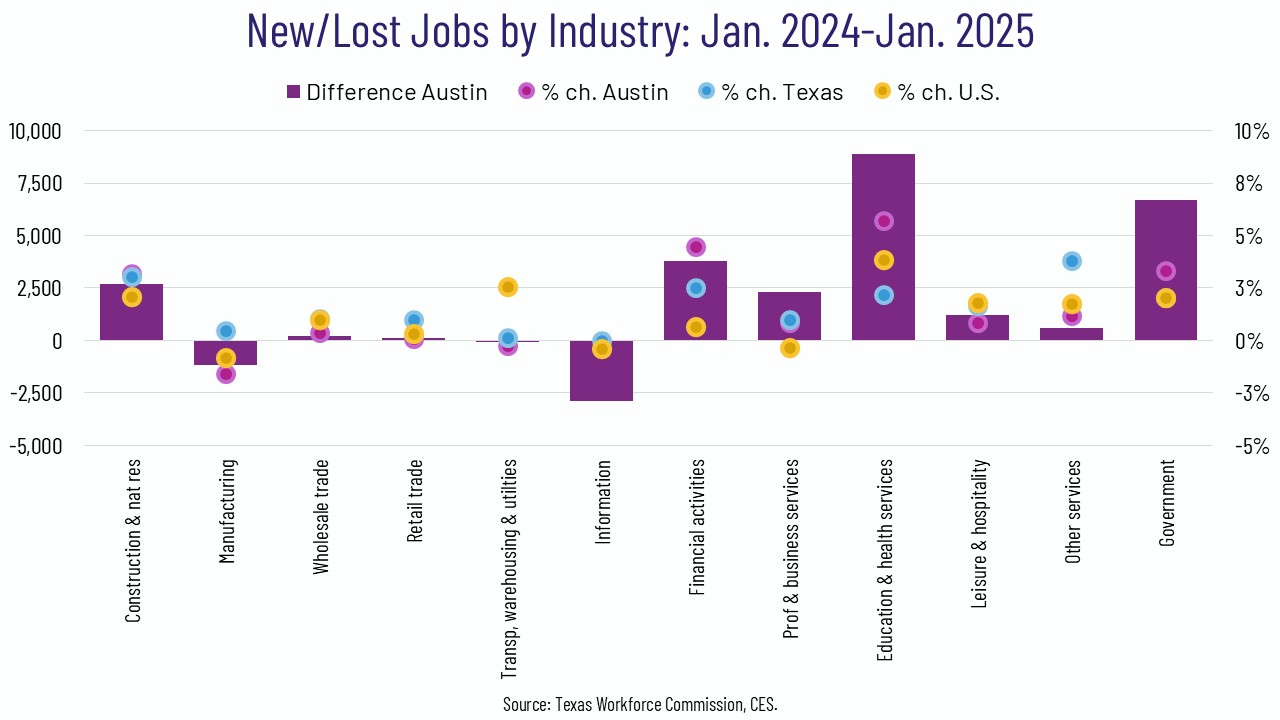
Statewide, the private industries with the most significant YOY growth are other services and construction, natural resources & mining, increasing 3.8% and 3.0% respectively. No industries lost jobs over the last 12 months.
Nationally, education & health services (3.8%) and transportation, warehousing & utilities (2.6%) were the leading private sector growth industries over the last 12 months. Manufacturing jobs were down 0.8%, while professional & business services and information were each down 0.4%.
Seasonally adjusted job growth in January was positive in Austin, gaining 300 jobs or 0.02% since December. The other Texas metros also saw positive monthly growth in the seasonally adjusted series with Houston performing best at 0.27%, while San Antonio (0.03%) and Dallas (0.01%) saw minimal growth. Statewide, seasonally adjusted jobs are up by 25,600 jobs or 0.2%. Nationally, seasonally adjusted jobs are up 0.1%.

Labor force, employment & unemployment
In January, Austin’s not-seasonally-adjusted unemployment rate is 3.5%, unchanged from January of last year. Rates in the other major Texas metros range from 3.8% in both Fort Worth & San Antonio to 4.4% in Houston, while Dallas is at 3.9%. The Dallas and San Antonio rates are unchanged from last year, while Fort Worth is improved by 0.1 percentage points and Houston is 0.1 percentage points higher than last year. The statewide rate is now 4.1%, unchanged from January of last year. The national unemployment rate is 4.4%, up from 4.1% a year ago.
Although Austin’s unemployment rate is traditionally lower than Texas’ other major metros, among U.S. major metros, Austin ranks as having the twelfth lowest rate in January.

On a seasonally adjusted basis, Austin’s February unemployment rate is 3.5%, up from 3.4% in January. Texas is at 4.1%, unchanged from January, while the national rate in February is 4.1%, up from 4.0%. Seasonally adjusted unemployment rates for Texas metros are produced by the Federal Reserve Bank of Dallas. (The Texas Workforce Commission also produces seasonally adjusted rates for Texas metros, but publication lags the Dallas Fed’s estimates.)

Conclusion
Each March, the U.S Bureau of Labor Statistics revises their CES data with benchmark revisions, updating the monthly data collected from a sample survey of businesses to a larger census of non-farm payroll employers. With the revised data, job growth in Austin was shown to be better than previously thought for 2024, bringing the total jobs created through December 2024 to 28,500 jobs (2.1%) up from 22,700 jobs (1.7%). This improvement is reflected in a gain of five spots in a ranking of the Fastest Growing Major Metros for job growth in 2024 with Austin now placing fifth instead of tenth. The benchmark revisions also reversed last year’s trend that we were observing which showed Texas job growth outpacing Austin’s for much of the year. Now for 2024, Texas job growth was 1.4% versus the preliminary estimate of 2.0%.
In January, Austin had the twelfth lowest unemployment rate among the U.S. major metros. At 3.5%, Austin’s unemployment rate is unchanged from January of last year. Austin’s labor force grew by 38,183 over the last year, but the total number of unemployed only grew 500 people.