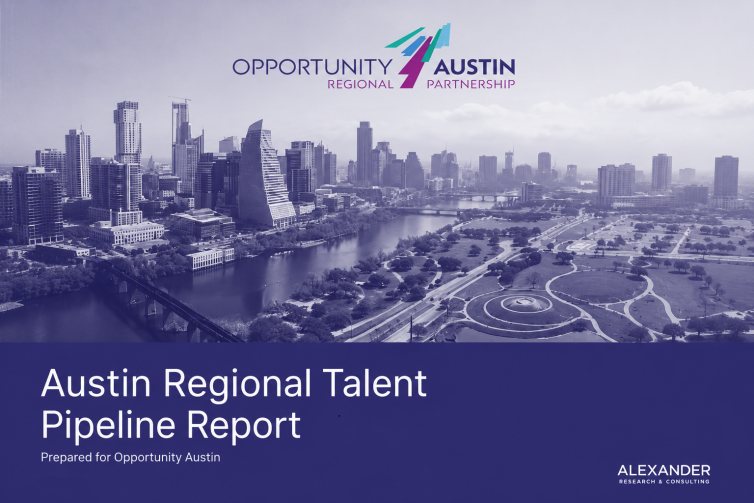
Universities play a pivotal role in shaping the Austin region’s economic future, serving as engines of innovation, workforce development, and business collaboration. From strengthening industry partnerships to expanding research initiatives, higher education institutions are equipping students with the skills necessary to drive long term economic growth.
A Deep Talent Pool
Today, the Austin region’s workforce is young, educated, and growing rapidly. With 160,000+ students across 25 area colleges and universities and a labor force participation rate among the highest in the U.S., the region continues to attract both talent and employers.
Austin ranks as one of the Most Educated Cities in the U.S.
- Ranked 8th by WalletHub, 2024
These strengths have positioned Austin as a top-ranked hub for innovation, talent retention, and workforce readiness. The University of Texas at Austin plays a central role in this success, drawing 94,000+ applicants annually and producing graduates who help drive industry growth.

“UT empowers students at every level—from undergraduates to PhDs—to think entrepreneurially while also offering key certificates for upskilling. We focus on preparing the next generation of talent and equipping the current workforce with the skills needed to adapt to evolving industry demands. Through curriculum updates, graduate programs that bridge academia and business, and accessible continuing education in fields like AI and data science, we ensure that university-level education directly benefits both students and the regional economy.”
Dr. Art Markman,
Senior Vice Provost at UT Austin

Innovation & Industry Collaboration
Beyond its role in talent development, UT Austin is deeply integrated into Austin’s business ecosystem, forming corporate partnerships, advancing research, and fostering entrepreneurship. The Austin Technology Incubator and the upcoming Innovation Building at the UT Medical Center are two examples of how the university is shaping the region’s future.
Texas State University’s STAR Park provides companies with access to R&D resources that help commercialize new technologies, scale innovations, and strengthen Austin’s competitive edge. These commercialization efforts drive economic growth, deepen industry-university collaboration, and create opportunities for startups in AI, materials science, and life sciences.

“At Texas State, we are intentional about aligning our research and innovation efforts with industry needs, particularly in areas like AI, materials science, and more. By forming strategic partnerships with businesses and startups, we’re driving technological advancements that have a direct impact on Central Texas. Through STAR Park and our industry collaborations, we’re not only strengthening the region’s innovation ecosystem but also creating career pathways that connect top talent with meaningful opportunities.”
Harold Strong,
Director of STAR Park
The Road Ahead
As Austin’s economy continues to expand in industries like AI, semiconductors, and cybersecurity, universities must evolve to keep up. UT and Texas State are adapting their curricula, strengthening apprenticeship and internship programs, and launching innovative workforce training initiatives to ensure students are ready for an ever-changing job market.
At the same time, fostering an entrepreneurial mindset will be key to maintaining Austin’s leadership in innovation. Encouraging creative problem-solving, interdisciplinary collaboration, and startup culture from an early stage ensures that Austin’s workforce remains adaptable, future-focused, and ready to drive economic progress.
However, challenges remain. Affordability, skill gaps, and evolving workforce models impact talent retention. Housing costs, in particular, make it harder for graduates to stay and build careers in the region, while fast-moving industries require ongoing investment in education and reskilling.
By strengthening collaboration between universities, businesses, and policymakers, Austin is positioned to sustain its economic momentum and remain a hub of opportunity, innovation, and workforce development.