

Insights
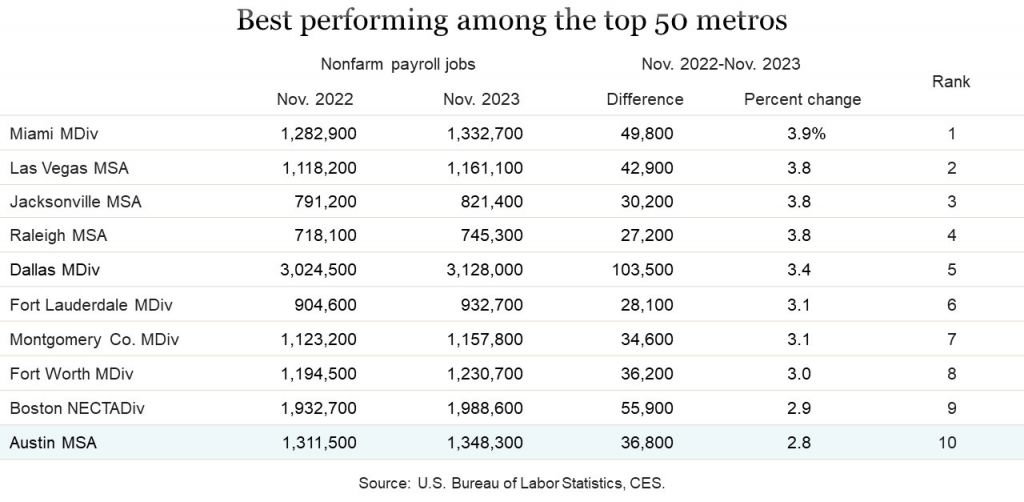
- Austin is the 10th best performing among the top 50 metros, adding 36,800 jobs, 2.8% growth, in the year ending in November.
- The fastest job growth over the last 12 months occurred in Austin?s construction and natural resources (10.3%) and education and healthcare (6.0%) industries.
- Austin?s seasonally adjusted unemployment rate decreased to 3.4% in November from 3.6% in October.
Nonfarm payroll jobs
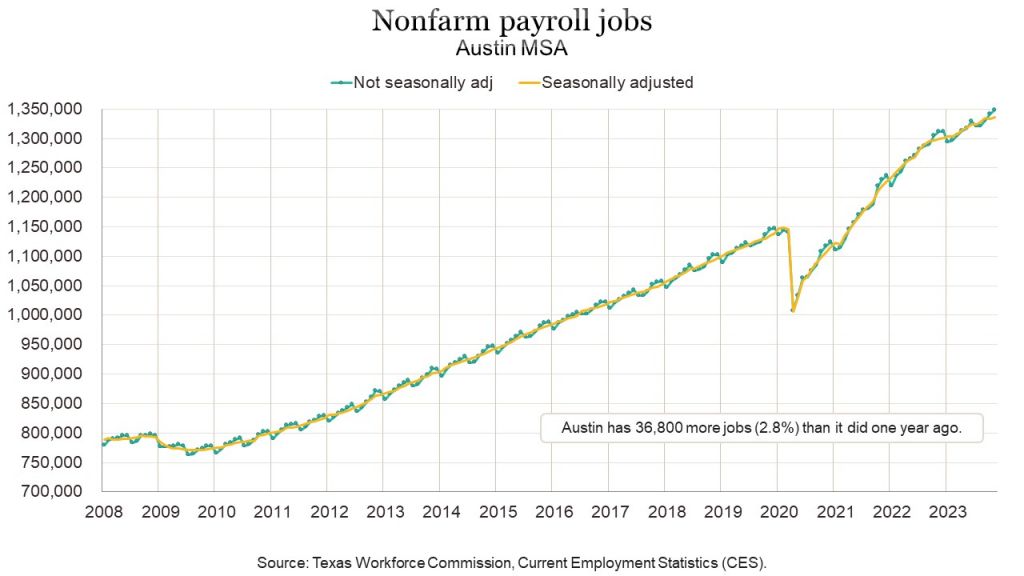
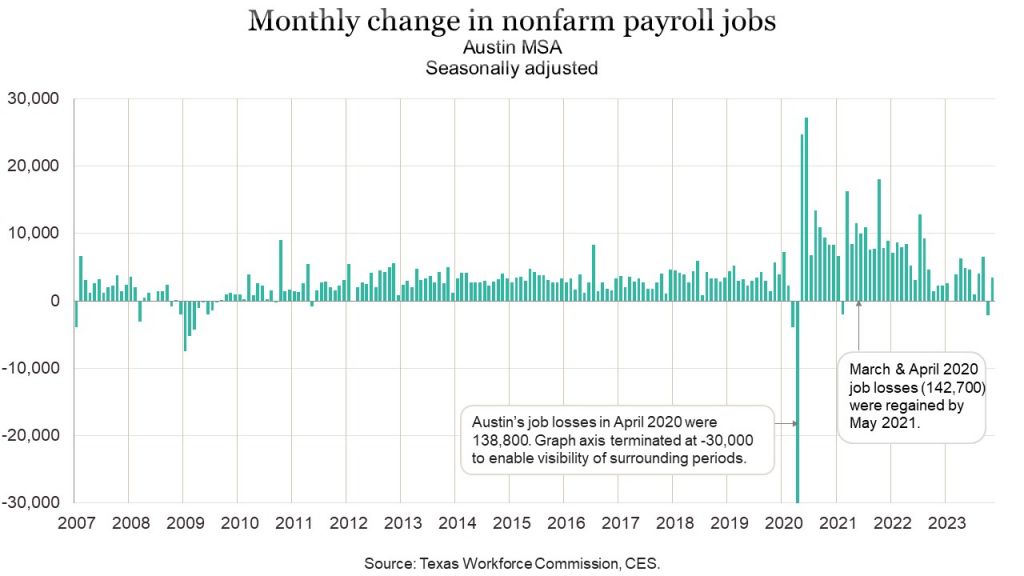
Austin?s November nonfarm payroll jobs total is up by 36,800, or 2.8%, over the last 12 months according to Friday?s releases of monthly labor market data by the Texas Workforce Commission and the U.S. Bureau of Labor Statistics. On a seasonally adjusted basis, Austin jobs increased by 3,500 or 0.3% from October to November.
Austin?s year-over-year increase of 2.8% makes it the 10th best performing among the 50 largest metro areas. Faster growing Dallas (3.4%) and Fort Worth (3.0%) also place in the top 10, while San Antonio (2.6%) and Houston (2.3%) rank 13th and 17th.
For the year ending in November, private sector job growth in the Austin MSA is 2.7%, or 29,900 jobs, with gains across seven of the 11 major private industry sectors. Customarily, slower job creation in the government sector drives overall job growth lower than private sector job growth in Austin. That has not been the case over the last few months. Government year-over-year job growth is uncommonly strong in November (3.7% or 6,900 jobs).
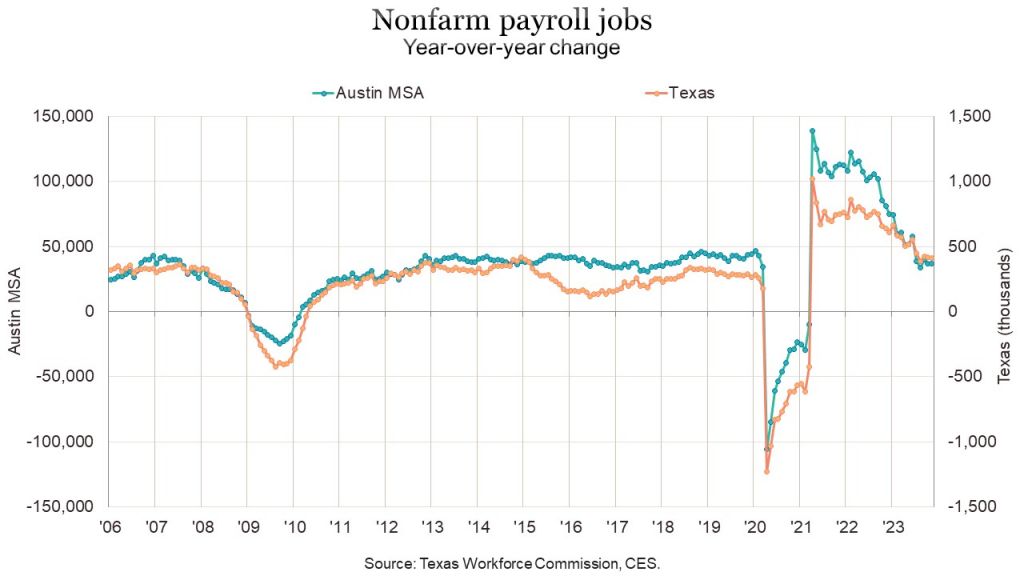
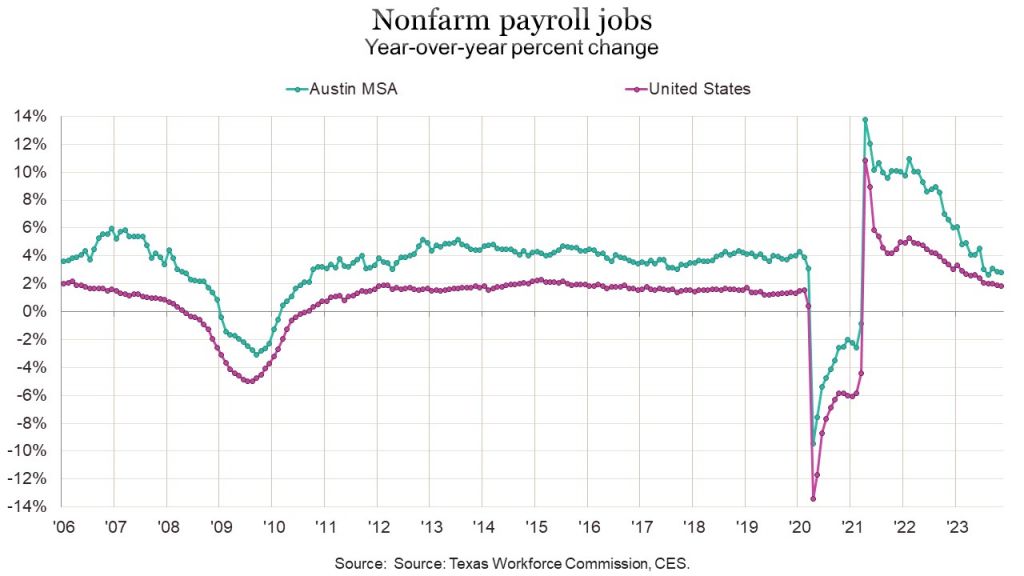
Texas saw net private sector job growth of 3.0% with each of the private industry groups adding jobs over the last 12 months. Total job growth was also 3.0% as the government sector grew at a roughly comparable 2.7% rate. For the nation, private sector job growth was 1.6% for the 12 months ending in November with all but two private industries adding jobs. Overall job growth was slightly higher at 1.8%, due to robust 2.9% government sector growth.
Jobs in November are up by 6,900 or 0.5% from October in the not-seasonally-adjusted series for Austin. However, the seasonally adjusted series shows a gain of 3,500 jobs or 0.3%. Seasonally adjusted jobs are also up in San Antionio (0.2%) and Houston (0.1%), but down in Dallas (0.2%), and essentially unchanged in Fort Worth. Statewide, seasonally adjusted jobs are up by 26,800 or (0.2%). Nationally, seasonally adjusted jobs are up from October by 199,000 or 0.1%.
In Austin, seven of the 11 major private industry sectors added jobs over the last 12 months, most notably construction and natural resources (10.3% or 8,100 jobs) and education and health services (6.0% or 8,700). Professional and business services added the most jobs, 13,400 (4.7%). Wholesale trade (-4.5% or -2,600 jobs), leisure and hospitality (-2.3% or -3,400), manufacturing (-2.1% or -1,500), and information (-1.5% or -800) saw negative year-over-year growth.

Statewide, over the last 12 months, all private industries added jobs. The industries with the most significant growth are construction and natural resources (5.1%) and education and health services (4.8%).
Nationally, all private industries, but two, added jobs over the 12 months ending in November, led by education and health services (up 4.2%) and leisure and hospitality (3.2%). Information (-3.1%) and transportation, warehousing and utilities (-0.6%) lost jobs.
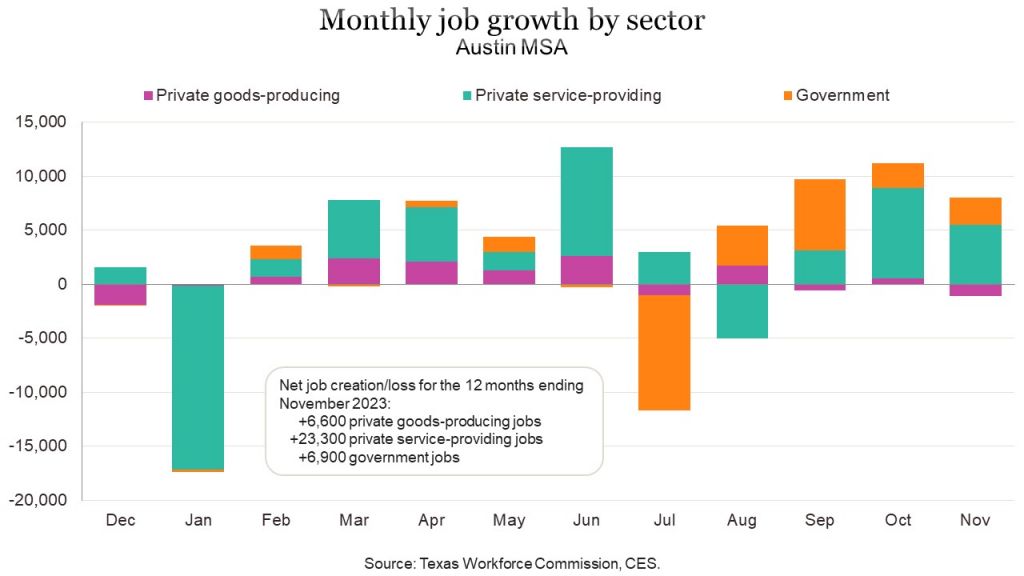
Over the last 12 months, the net gain for private service-providing industries in Austin is 23,300 jobs, or 2.4%. Employment in goods-producing industries is up by 6,600 jobs or 4.4%. Statewide, private service-providing industries are up 276,000 or 2.8%, and goods-producing industries are up 81,600 or 4.2%.
Additional graphs: New/lost jobs by industry for Oct. 2023-Nov. 2023 and the trend since 2000 for six large industries and six small industries.
Labor force, employment & unemployment
We also now have November labor force, employment, and unemployment numbers for Texas and local areas in Texas. The same data for all U.S. metros will not be released by the U.S. Bureau of Labor Statistics until January 4. In October, Austin had the 27th lowest rate of unemployment among the 50 largest metros. Unemployment numbers for November show Austin?s performance relative to the state and other major Texas metros being sustained.
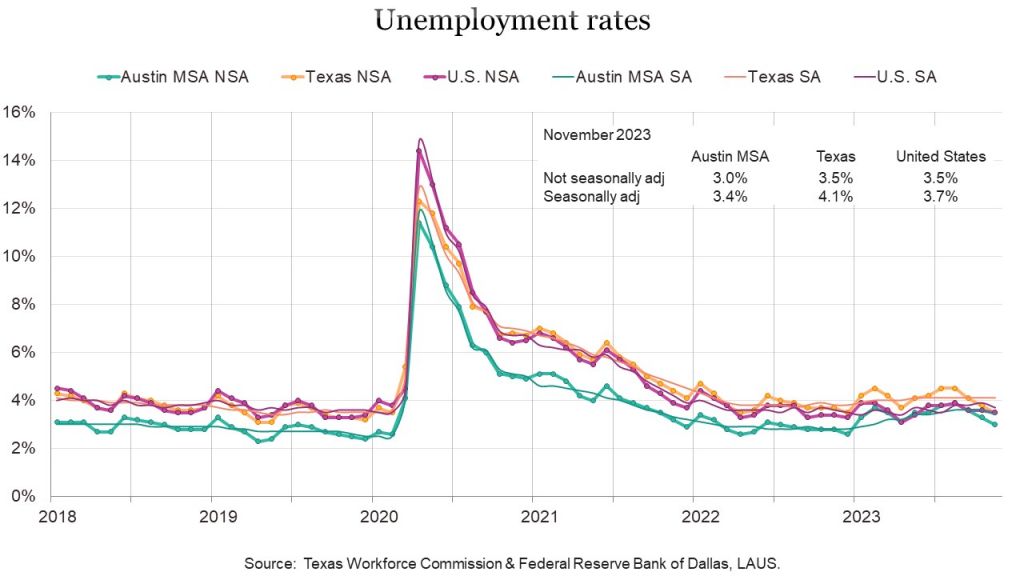
In November, Austin?s not-seasonally-adjusted unemployment rate is 3.0%, which is an increase of 0.2 percentage points above where it was one year ago (2.8%). Rates in the other major Texas metros range from 3.3% in Dallas and Fort Worth to 3.8% in Houston. Dallas is unchanged, but the other metros? current rates are 0.1 to 0.3 percentage points below the rates one year ago. The statewide rate is now 3.5%, down from 3.7% in November of last year. The national unemployment rate is also 3.5%, up from 3.4% a year ago.
November unemployment rates are 2.9% in Hays County, 3.0% in Bastrop and Travis Counties, and 3.1% in Caldwell and Williamson Counties.
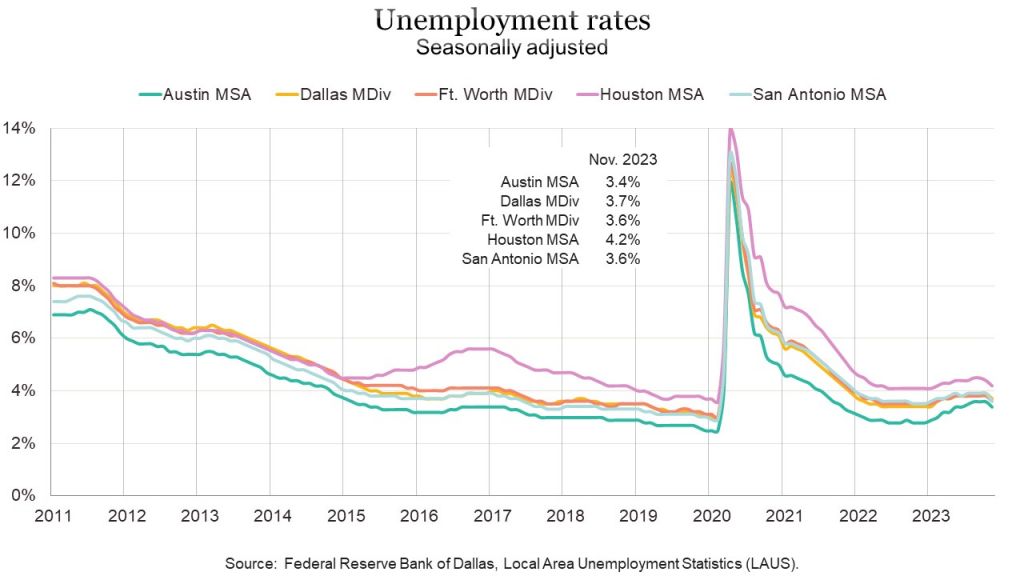
On a seasonally adjusted basis, Austin?s November unemployment rate is 3.4%, improved from 3.6% in October. The statewide rate is 4.1%, unchanged from October. The national rate is 3.7%, down from 3.9% in October.
Among Texas? other major metros, Fort Worth and San Antonio are at 3.6%, Dallas is at 3.7%, and Houston is at 4.2%. Seasonally adjusted unemployment rates for Texas metros are produced by the Federal Reserve Bank of Dallas. (The Texas Workforce Commission also produces seasonally adjusted rates for Texas metros, but publication lags the Dallas Fed?s estimates.)
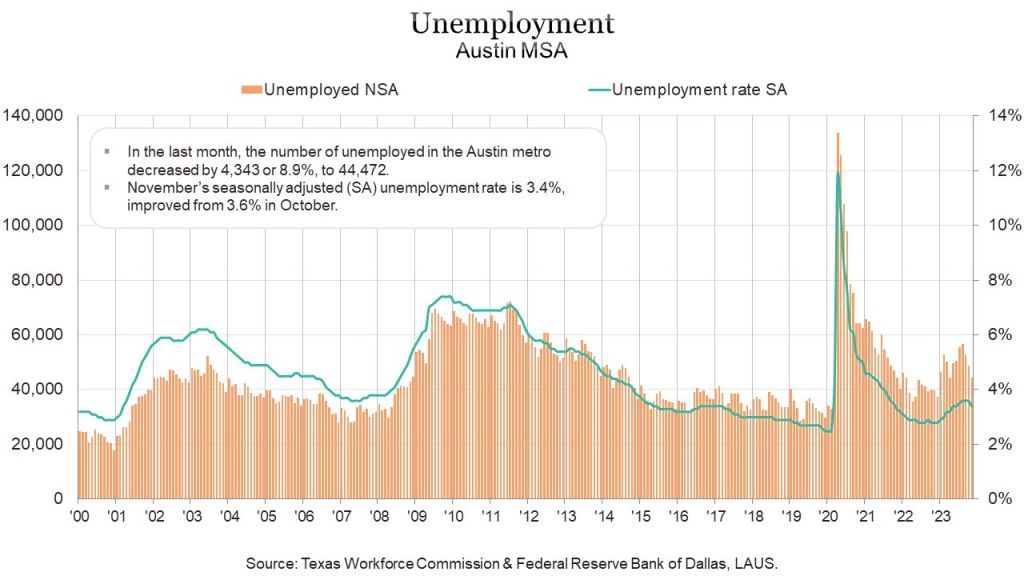
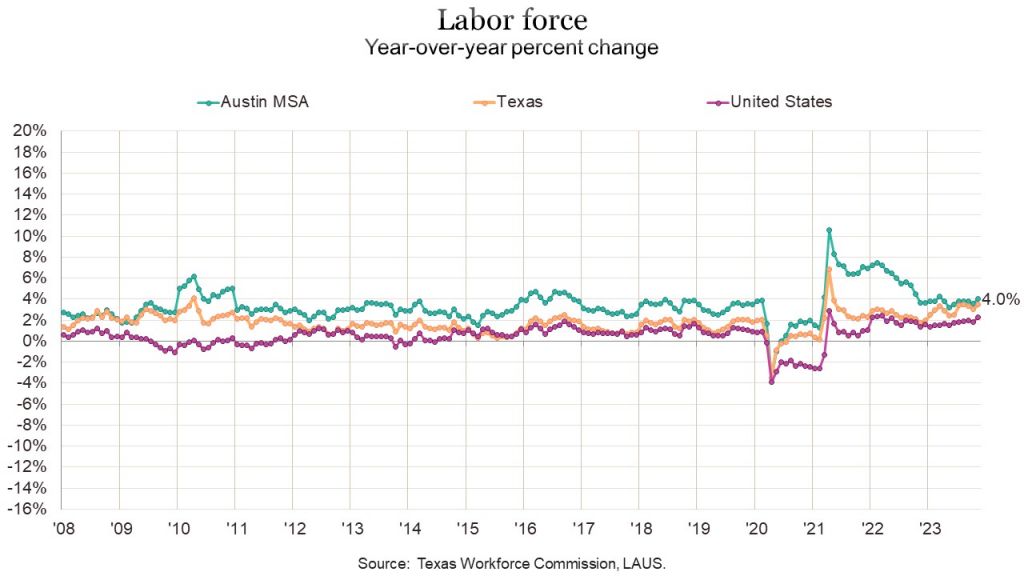
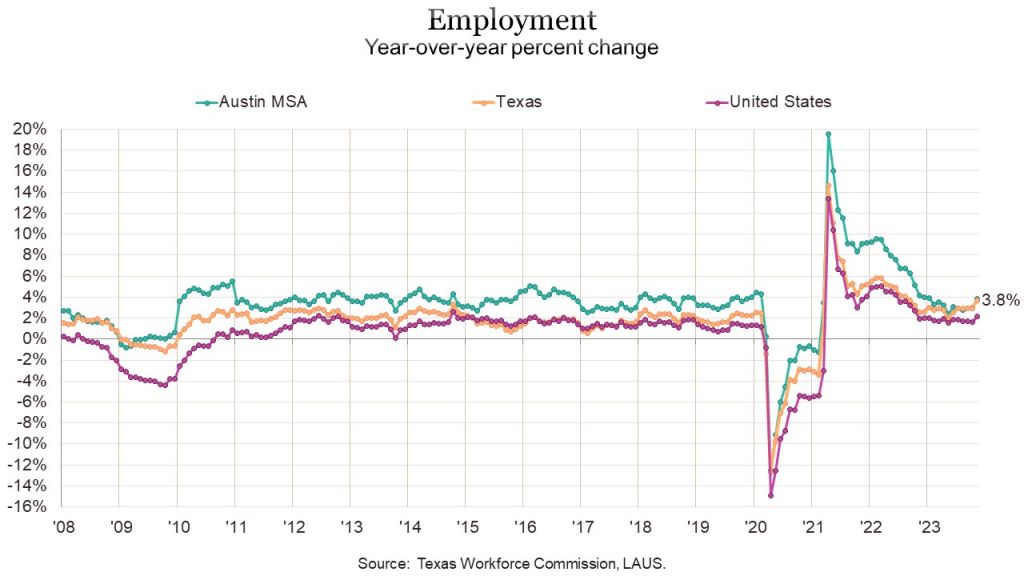
With Austin?s unemployment rate up from one year ago, the number unemployed has also risen. In November 2022, Austin?s number of unemployed was 39,573. Over the last 12 months, the unemployed increased by 4,899 or 12.4%, to 44,472. This is due to a larger increase in the labor force, compared to the number employed. The Austin metro?s civilian labor force (employed plus unemployed) increased by 57,155 persons or 4.0% from one year ago, while persons employed increased by 52,256 or 3.8%.

Additional graphs ? Labor force & employment: Texas and United States
Texas? labor force growth (511,258 or 3.5%) over the last 12 months is lower than the growth in the number employed (519,166 or 3.7%). Thus, the number of unemployed fell by 7,908 or 1.5%. Nationally, November civilian labor force is up by 3.7 million or 2.3%, while the number of employed is above the level of a year ago by 3.4 million or 2.1%, and 304,000 more people (5.5%) are unemployed.
Conclusion
Recent months have seen Austin?s and Texas? job growth slow. Austin?s year-over-year job growth averaged 2.9% over the last five months, following an average of 4.5% for the preceding five months. Nevertheless, Austin achieved stronger growth than all but 9 of the 50 largest metros for the 12 months ending in November. For Texas, growth averages are 3.1% for the last five months, following 4.1% in the preceding five months. Year-over-year growth slowed to an average of 2.0% nationally over the last five months, after averaging 2.6% in the preceding five.
Austin?s seasonally adjusted unemployment rate dropped to 3.4% in November from 3.6% in October. Texas? rate held steady at 4.1% and the national rate ticked down from 3.9% to 3.7%. While the number of unemployed in Austin is higher than it was a year ago, it is at its lowest level since April.
The Texas Workforce Commission and the U.S. Bureau of Labor Statistics will release December estimates on January 19.
###
Until recently, this monthly article on the labor market releases included tracking of the pandemic recovery in Austin. While the fullness of recovery varies from industry to industry, and the unemployment rate remains above 2019?s average, Austin is otherwise securely recovered from the pandemic. Therefore, we are reverting to our customary focus on month-over-month and year-over-year trends. If you would like to review post-pandemic performance, the last article that included observations of this is October 2023. The CES and LAUS spreadsheet files on our Economic Indicators page will continue to include change from the last pre-pandemic month to the current month.