

The Austin economy
Opportunity Austin is pleased to announce a reenvisioned monthly Economic Indicators report. The new report features 14 data points highlighting the economic vitality of the Austin Metro area. This report along with the associated data files utilized to compile the report will be sent to subscribers of the By the Numbers newsletter and posted on our website’s “News section” by the middle of each month. Here are some takeaways from this month:
- Similar to the U.S. & Texas, Austin’s YTD job growth slowed from 30.2K jobs added in 2024 to 15.9K added in 2025.
- For August 2025, the unemployment rate in the region was 3.9%, up from 3.8% in August 2024. Austin’s rate continues to perform better than TX at 4.7% and the U.S. at 4.5%.
- Growth in Austin’s Business Cycle Index slowed to 2.6% for the first 8 months of 2025, compared to 3.1% in 2024. YTD growth in the other major metros was between 1.2% in Houston to 3.1% in Dallas. San Antonio was at 2.3% and Fort Worth was at 2.1%.
- July 2025 was the fifth busiest month at AUS airport with 2.036 million passengers. YTD passenger activity was down slightly from 12.86 million last year to 12.36 million in 2025.
Non-Farm Payroll Job Growth
Revised job growth for the Austin region was 2.2% in 2024 adding 29,400 jobs. Like this time last year, the preliminary Bureau of Labor Statistics (BLS) monthly job releases are showing softer job growth for the region. Jobs added YTD 2025 exceed YTD 2024 by 15,900 jobs or 1.2%.
Austin’s job growth of 0.7% from August 2024 to August 2025 trailed the overall rate in TX, 1.1%; and the US, 0.8%. Austin was the 24th best performing of the Top 50 metros. Despite, the unusually low ranking for Austin, only 2 metros saw growth over 2.0% and Austin was just 0.5% from 12th place.
Source:U.S. BLS, CES.

Top Job Gains/Losses by Industry, August 2025
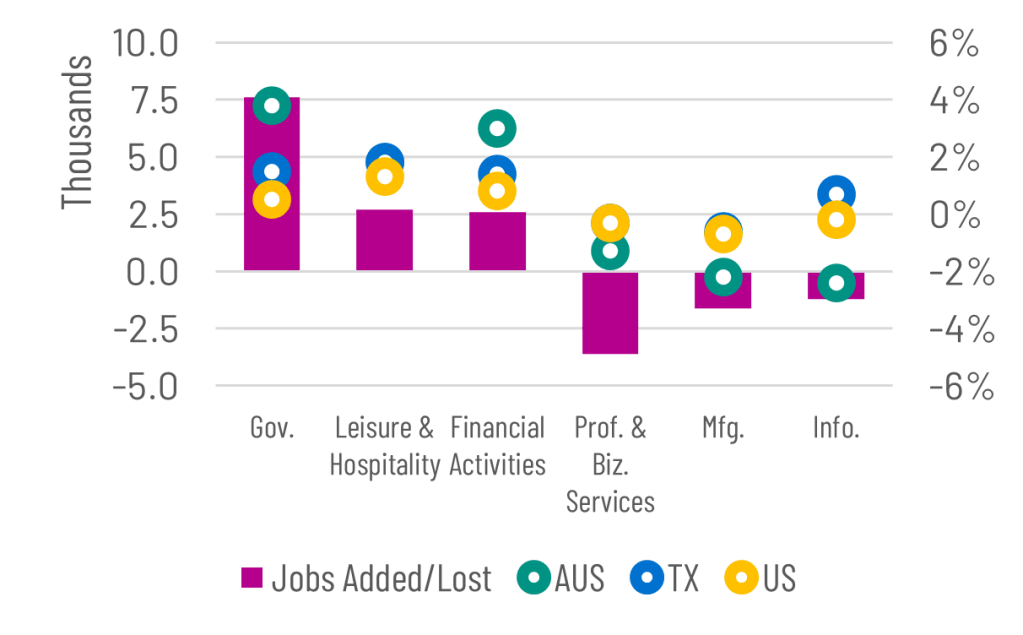
The best performing industries in Austin over the last year were Government (up 7,600, 3.8%), Leisure & Hospitality (2,700, 1.8%), and Financial Activities (2,600, 3.0%). Austin’s growth rate for Financial Activities outperformed both the TX and the US, while Leisure & Hospitality growth in Austin matched TX’s growth in that sector and overperformed the US.
The worst performing industries were Professional & Business Services (-3,600 , -1.3%), Manufacturing, (-1,600 , -2.2%), and Information (-1,200, -2.4%). Each of these industries performed better in TX & US overall. TX had positive growth for Information, but also saw negative growth in Prof. Biz Services and Mfg. employment.
Source:U.S. BLS, CES.
Unemployment
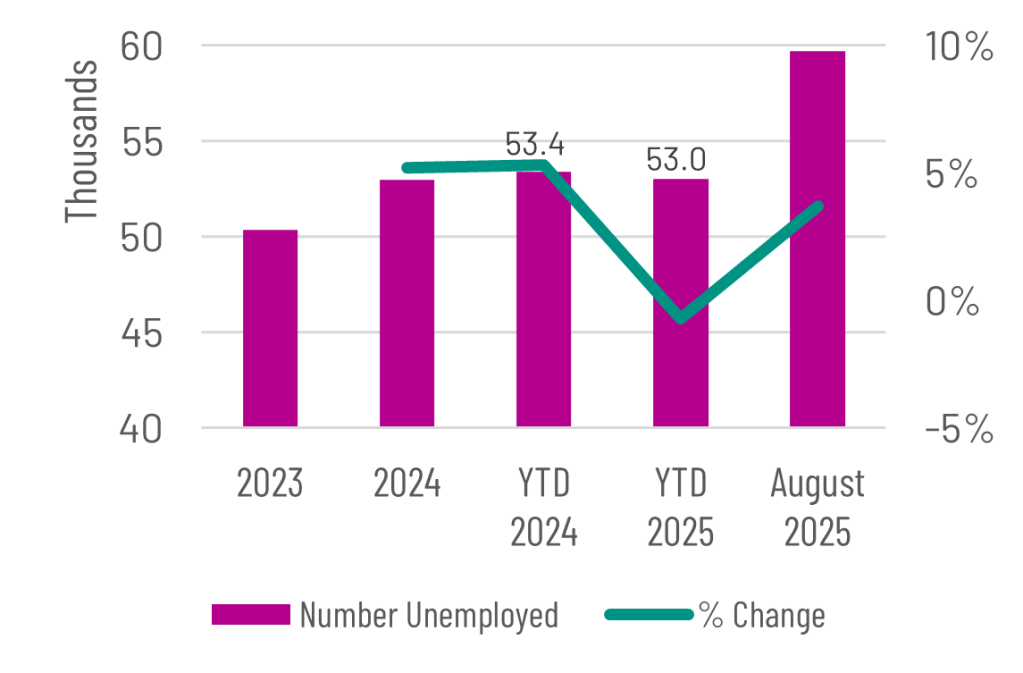
The recent low mark for the total number of unemployed in the Austin region was in 2022 with just 42,100 out of work jobseekers. Both 2023 and 2024 saw increases in the total number of unemployed. For YTD 2025 Austin has slightly less unemployed, 400, compared to YTD 2024.
In August 2025, the number unemployed totaled 59,700, which is 2,100 more people than August 2024 when the total unemployed was 57,600. TX has 43,500 more unemployed compared to this time last year, while the US had 332,000 more unemployed.
Source: U.S. BLS, LAUS.
Unemployment Rate Comparison
The unemployment rate for the Austin region was 3.9% in August 2025, which was 0.1 higher than the rate one year ago. Austin’s rate continues to perform better than that of TX at 4.7% and the U.S. at 4.5%. Additionally, Fort Worth, 4.3%; San Antonio & Dallas, 4.4%; and Houston, 5.0% were all higher than Austin’s rate.
Since recovering from a peak of 11.5% during COVID, Austin’s rate averaged 4.2% in 2021, 3.0% in 2022, and 3.5% in both 2023 & 2024. TX’s rate rose to 12.3%during COVID and declined to 5.6% in 2021 and has since averaged 4.0% the last 3 years. The US rate reached 14.4% in COVID and declined to 3.5% in 2022 & 2023 but rose to 4.0% in 2024.
Source: U.S. BLS, LAUS.

Workforce Hours & Earnings
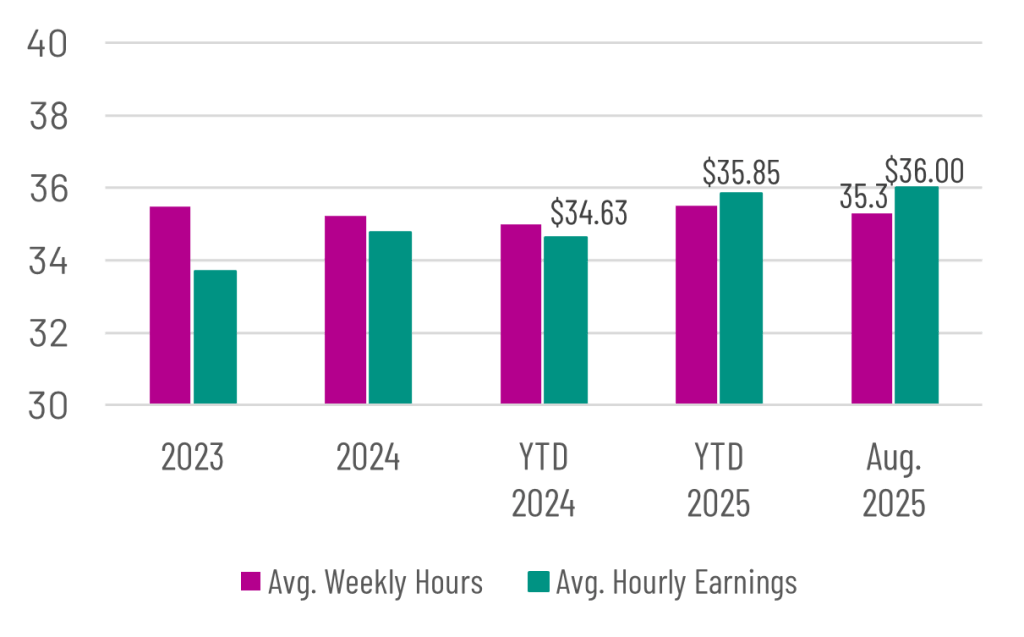
The average number of hours worked for payroll jobs in the Austin region in August 2025 was 35.3, down from 35.6 this time last year. For 2025 YTD, hours worked is up 1.5% from 2024 YTD. Texas employees also worked more hours this year, compared to last; however, for the US the avg. was unchanged.
Average hourly earnings have risen on average 3% in Austin the last two years, while the average earnings in TX were up 5% and in the US 4.2%. For the first 8 months of 2025, average earnings in Austin were up 3.5% from $34.63 to $35.85. Increases both in the TX and the US were more profound at 4.7% and 4.0%, respectively.
Source:U.S. BLS, CES.
Metro Business Cycle Index
The Austin metro’s business cycle index continues to show growth in both the YTD and YOY comparison through August. After robust growth of 11 to 13% in 2021 & 2022, the rate slowed to 2.6% for YTD 2025 compared to YTD 2024 growth of 3.1%.
Statewide, the business cycle index grew by 3.5% from YTD 2024 to YTD 2025. Across Texas YTD growth in the other major metros was between 1.2% in Houston to 3.1% in Dallas. San Antonio was at 2.3% and Ft. Worth was 2.1%. Produced by the Federal Reserve of Dallas, the business cycle index reflects broad economic conditions including unemployment, inflation-adjusted wage and retail sales growth.
Source:Dallas Federal Reserve.

Consumer Price Index
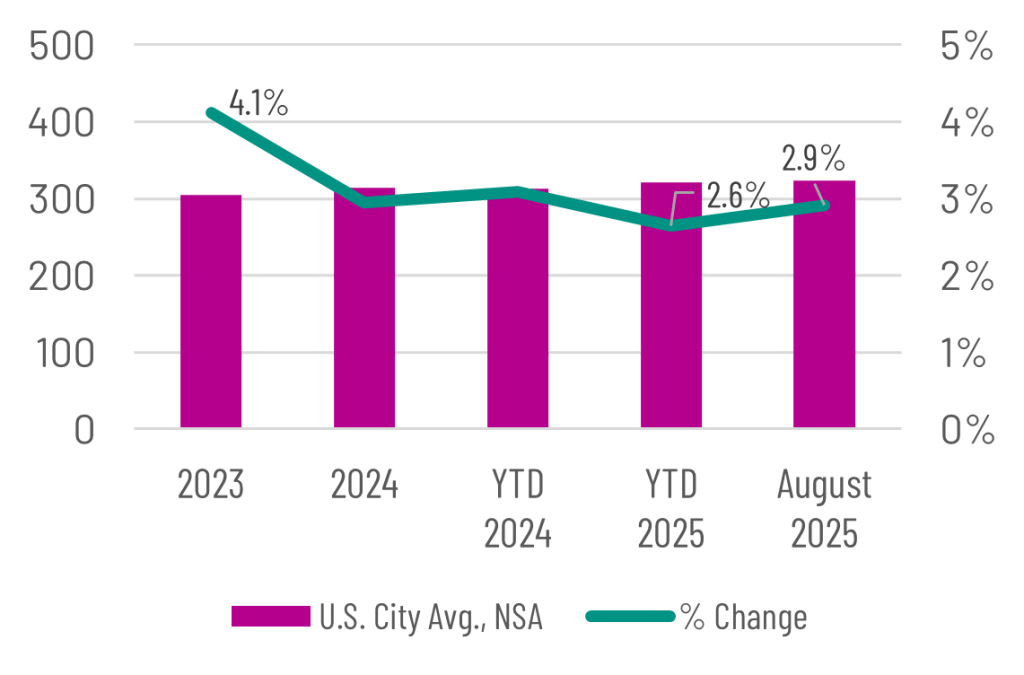
After reaching a 40-year high of 8.0% in the annual percent change in 2022, the U.S. Consumer Price Index fell to 4.1% in 2023 and 2.9% in 2024. Year over Year change in August 2025 was 2.9%, slightly higher than the 2025 YTD increase of 2.6%.
While a CPI is not produced for the Austin metro, the Houston metro index was up 1.1% in August over the same time last year, while the Dallas metro index was up only 0.9% in July 2025. The CPI index for these two areas are only produced every other month. Some of the biggest contributors to increasing inflation in the Index were Natural Gas, up 13.8%; Electricity, up 6.2%; Medical Services, up 4.2%; Shelter, up 3.7%; and Food, up 3.2%.
Source:U.S. BLS, CPI
Sales Tax Receipts
Sales tax allocation payments to the City of Austin grew 3.3% in 2023 and 2.4% in 2024. However, year to date through September 2025, receipts are down by 0.8% compared to the same time last year, but payments to Austin were up 2.2% in September 2025 compared to September 2024.
In Round Rock, receipts were up 1.4% in 2023 and down 1.4% in 2024, San Marcos received 4.2% more funds from sales tax payments in 2023 and 2.1% less in 2024. For Sep. YTD, Round Rock’s sales are up 10.1% from 2024 YTD and San Marcos was down -1.6%. Statewide, Sep. 2025 YTD sales tax collections are up 4.2% compared to YTD 2024.
Source: Texas Comptroller

AUS Airport Passenger Activity
Annual passenger counts through the Austin airport hit a record 22.1 million in 2023 and fell 1.5% in 2024. Through July 2025, YTD totals are 12.36 million down from the same time last year at 12.86 million. July 2025 was the 5th- busiest month of all time with 2.036 million passengers, however, compared to the same month last year, passengers were down 3,500 or -0.2%.
Total cargo (including Belly freight, cargo and mail) totaled 301.9 million pounds in 2024, up 6.7% from 283.1 million pounds in 2023. The annual record for total cargo occurred in 2022 with 310.1 million pounds transported. For July 2025, YTD cargo totaled 157.1 million pounds, which was an 11.0% decrease from the same time last year.
Source: City of Austin

Patent Activity
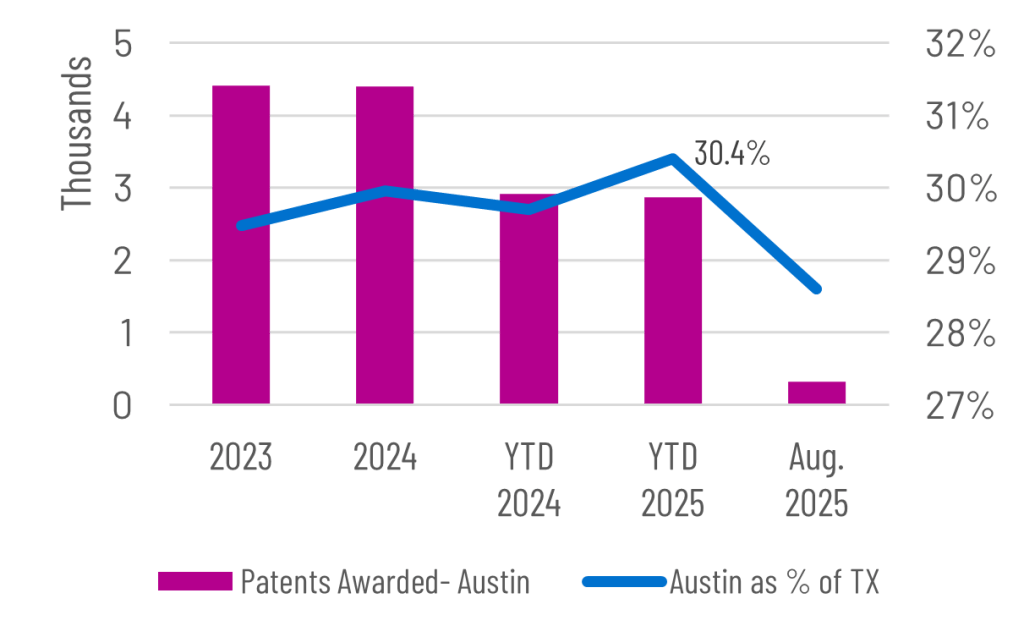
Austin inventors are averaging an impressive 4,500 patents awarded each year during the 2020’s, which is higher than the 3,750 averaged during the 2010’s. Patent activity in August 2025 increased to 320 from 280 during the same month last year. However, YTD patent activity is down 1.9% to 2,863 in 2025.
Austin continues to represent approximately 30% of patent activity in TX. This is a truly remarkable data point since the Austin MSA only represents around 8% of the entire population of the State. Despite a lower number of patents awarded in Austin for YTD 2025, Austin’s share of TX patents increased to 30.4% from same time last year due to even slower patent growth for TX as a whole.
Source:U.S. Patent & Trademark Office.
Venture Capital Investment
Venture Capital funding in Austin totaled $3.6 billion in 2024, down by 26% from 2023 funding of $4.23 billion. However, for Q1 and Q2 2025, VC funding was $3.56 billion, nearly topping the total for all of 2024. The top five funding rounds for 2025 include: Saronic, $600M; NinjaOne, $500M; Apptronik, $403M; Base Power, $200M; HalcyonAI, $125M.
Austin’s share of VC funding nationwide was 1.7% in 2024, down from 2.6% in 2023. For YTD 2025, Austin’s VC funding represents 2.2% of U.S. total funding. Statewide, Austin startups garnered 52.1% of all VC funding. Total number of VC deals in Austin were 171 in YTD 2025, down from 199 during the same time last year.
Source: Pitchbook.

Housing Permit Activity
Building permits issued in the Austin region came down from historic highs of between 22,000 to 25,500 units in 2021 and 2022. Last year a total of 15,000 units were issued down 16.7%. For YTD 2025, a total of 17,400 units have been issued down from 22,400 or -22.3% from the same time last year. Nationally, permits were down 2.6% in 2024 and for YTD 2025 US permits are about 4.4% off last years pace.
Last year in the Austin region, the share of single-family units, 51.1%, exceeded multifamily for the first time since 2021. For YTD 2025, 63.2% or 11,000 units were single family out of the 17,400 permitted units, compared to 6,400 that were multifamily.
Source: U.S. Census Bureau Building Permits Survey

Home Sales
Home sales in the Austin region peaked at 41,094 in 2021. For the last two years, total sales were about 30,500. In August, YTD sales are down by about 600 or 2.9% compared to the same time last year. Statewide, YTD sales in August were up 1.0% compared to 2024, while U.S. sales were down 1.2%.
The average sales price in the Austin region was $583,649 in August 2025, up from $570,658 one year ago. Likewise, the YTD sales price was trending slightly higher this year. In August 2025, months on inventory in Austin was 5.7 months, down from 5.9 early this summer. Months of Inventory is still 1 month higher than one year ago.
Source: TX A&M Real Estate Research Center

Commercial Real Estate Activity
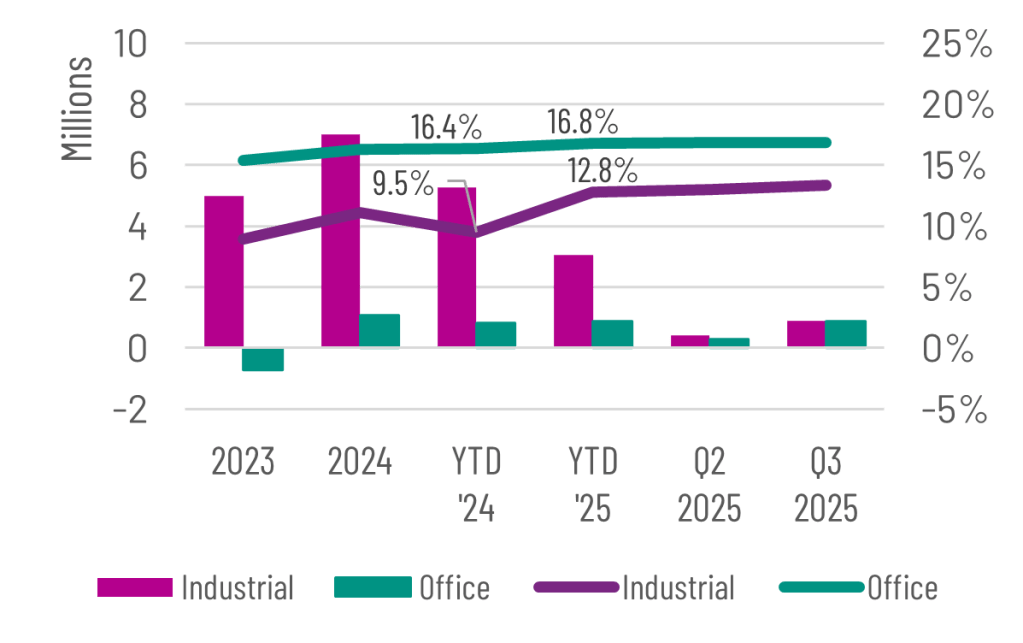
After having office vacancy rates of around 7 to 8% just before COVID in the Austin region, continued new construction delivery and softened leasing activity has brought the office vacancy rate up to 16.8% in 2025 compared to 16.4% in 2024. The current office market totals 138M SF, having added 18M SF of new inventory since Q2 2020. Quoted lease rates in 2025 Q3 ticked up to $43.84 from $42.81 in Q2.
Likewise, the Austin industrial market has grown to 173M SF, adding 58M SF since 2020 Q2 or 51% growth over 5 years. YTD vacancy rate in 2025 at 12.8% is up from 9.5% in 2024. Quoted rates ticked up slightly to $15.07 in 2025 Q3.
Source: CoStar
Upcoming Releases
Due to the Federal Shutdown which began on October 1st, the availability of Federal sources of data may be impacted. Normally, the Bureau of Labor Statistics would release monthly job data on October 17th. Should a shutdown continue beyond October 17th, September labor and wage data release would be delayed. State, local, and private data sources may also be delayed depending on their reliance of Federal information.
- Venture Capital data for 2025 Q3 will be released by Pitchbook on October 14th.
- Federal Reserve’s monetary policymakers will meet on October 28-29 to announce any changes to interest rates.
More Info & downloads
- Labor force, employment & unemployment
- Employees on nonfarm payrolls
- Hours & earnings
- Consumer price index
- Metro business cycle index
- Sales tax & retail sales
- Housing permits
- Home sales, listings & prices
- Air service
- Patent activity
- Commercial real estate
For questions about this data, please contact Chris Ramser, Vice President, Research (512.322.5662) or Joseph Morones, Director, Research.